


Serving Washington State Since 1995


AMERICAN STANDARD
FOR NURSERY STOCK
ANSI Z60.1–2004
Approved May 12, 2004
DEDICATION
This edition of the
American Standard for Nursery Stock is dedicatedin memory of Ronnie Swaim, Gilmore Plant & Bulb Co., Inc. (NC)
Copyright 2004 by American Nursery & Landscape Association
All rights reserved. No part of this book may be reproduced or transmitted in any form or by any means, electronic or
mechanical, including photocopying, recording, or by any information storage and retrieval system, without permission in
writing from the publisher.
American Nursery & Landscape Association
1000 Vermont Avenue, NW, Suite 300
Washington, DC 20005
www.anla.org
ISBN 1-890148-06-7
Foreword ..................................................................... i
Container size specifications .................................... ii
Container class table .............................................. iii
In-ground fabric bag specifications........................... iii
How to use this publication ...........................................iv
Horticultural standards committee...................................vi
Canvass list ................................................................vii
Section1: Shade and Flowering Trees
1.1 Specifications—general ............................... 1
1.1.1 Required specifications ........................................ 1
1.1.1.1 Plant size intervals............................................ 1
1.1.1.2 Methods of caliper and height measurement........ 1
1.1.2 Optional specifications and quality designations..... 2
1.1.2.1 Height and caliper ........................................... 2
1.1.2.2 Transplanting requirements................................ 2
1.1.2.3 Specimen or quality grade designation............... 2
1.1.2.4 Height of branching—street trees ....................... 2
1.1.2.5 Trees for other uses........................................... 3
1.2 Types of trees.............................................. 3
1.2.1 Type 1 shade trees .............................................. 3
1.2.2 Type 2 shade trees .............................................. 5
1.2.3 Type 3 small upright trees .................................... 6
1.2.4 Type 4 small spreading trees ................................ 7
1.3 Shrub form, clump form, or multi-stem trees... 8
1.3.1 Shrub form trees ................................................. 8
1.3.1.1 Definition ........................................................ 8
1.3.1.2 Specification ................................................... 9
1.3.1.3 Measurement................................................... 9
1.3.2 Clump form and multi-stem trees............................ 9
1.3.2.1 Definitions ....................................................... 9
1.3.2.2 Specification ................................................. 10
1.3.2.2.1 Clump form trees......................................... 10
1.3.2.2.2 Multi-stem trees ........................................... 10
1.3.2.3 Caliper measurements—clump form and multi-stem
trees ..................................................................... 10
1.3.2.4 Root ball sizes—shrub form, clump form and multistem
trees.............................................................. 11
1.3.2.4.1 Root ball diameters—shrub form trees............ 11
1.3.2.4.2 Root ball diameters—clump form trees ........... 11
1.3.2.4.2 Root ball diameters—multi-stem trees ............. 11
1.4 Palms ....................................................... 12
1.5 Bare root specifications ............................. 13
1.5.1 Nursery grown—spread of roots......................... 13
1.5.2 Collected—spread of roots................................. 14
1.6 Root ball guidelines .................................. 15
1.6.1 Root ball diameters—field grown trees................. 15
1.6.2 Trunk in center of root ball................................. 17
1.6.3 Root ball depths ................................................ 17
1.6.4 Burlapping ....................................................... 18
1.6.5 Ball-supporting devices ...................................... 18
1.6.6 Collected ......................................................... 18
1.6.7 Plantation grown............................................... 19
1.6.8 Field potted or field boxed ................................. 19
CONTENTS
AMERICAN NURSERY & LANDSCAPE ASSOCIATION
1.6.9 Processed balled............................................... 19
1.6.10 Use of digging machines ................................ 19
1.7 Container grown specifications................. 20
1.8 Box-grown .............................................. 21
1.9 In-ground fabric bag-grown..................... 22
SECTION 1 FIGURES AND TABLES
Figure 1—Caliper and branching height......................... 3
Figure 2—Measurement—type 2 shade trees .................. 5
Figure 3—Type 3 small upright trees............................... 6
Figure 4—Type 4 small spreading trees .......................... 7
Figure 5— Multi-stem, clump form, and shrub form trees ...11
Figure 6—Palms......................................................... 13
Figure 7—Measurement—field grown trees ................... 14
Figure 8—Example: trunk in center of root ball .............. 17
Figure 9—Measurement of root ball depths ................... 18
Table 1—Height/caliper relationship for type 1 shade trees ....4
Table 2—Height, caliper, and branching relationships—
type 3 small upright trees ......................................... 6
Table 3—Branching—type 4 small spreading trees........... 7
Table 4—Root ball sizes for shrub form and multi-stem trees...12
Table 5—Caliper/height/root spread relationship—
nursery grown bare root trees................................. 13
Table 6—Root ball diameters—field grown trees ............ 16
Table 7—Root ball diameters—processed balled trees .... 19
Table 8—Container class guidelines—shade and
flowering trees...................................................... 20
Table 9—Fabric bag sizes-trees ................................... 22
Section 2: Deciduous Shrubs
2.1 Specifications—general ............................. 23
2.1.1—Required specifications .................................... 23
2.1.1.1 Plant size intervals.......................................... 23
2.1.1.2 Definition of “cane”........................................ 23
2.1.1.3 Spread and height measurements .................... 23
2.1.2 Optional specifications and quality designations... 24
2.1.2.1 Minimum number of canes .............................. 24
2.1.2.2 Transplanting or root pruning .......................... 24
2.1.2.3 Specimen designation .................................... 24
2.2 Types of deciduous shrubs ........................ 24
2.2.1 Type 0—Tender shrubs....................................... 24
2.2.2 Type 1—Small or dwarf .................................... 25
2.2.3 Type 2—Intermediate ........................................ 26
2.2.4 Type 3—Large or tall ......................................... 27
2.3 Bare root specifications ............................. 28
2.3.1 Nursery grown—spread of roots......................... 28
2.3.2 Collected—spread of roots................................. 29
2.4 Root ball guidelines .................................. 29
2.4.1 Root ball diameters—field grown deciduous shrubs ...29
2.4.2 Plant in center of root ball .................................. 30
2.4.3 Root ball depths ................................................ 31
2.4.4 Burlapping ....................................................... 31
2.4.5 Ball supporting devices ...................................... 31
2.4.6 Field potted plants............................................. 31
2.4.7 Processed balled plants...................................... 32
2.4.8 Collected plants ................................................ 32
2.4.9 Plantation grown plants ..................................... 32
2.4.10 Use of digging machines ................................ 32
2.5 Container grown specifications.................. 33
2.6 In-ground fabric bag-grown..................... 34
SECTION 2 FIGURES AND TABLES
Figure 10—Types of deciduous shrubs.......................... 27
Figure 11—Typical type 2 intermediate deciduous shrubs ...28
Figure 12—Center of plant in center of root ball ............ 30
Figure 13—Measurement of field grown deciduous shrubs....30
Figure 14—Ball depths: field grown deciduous shrubs .... 31
Table 10—Height or spread relationship to number of canes
and spread of roots or root ball diameter—
type 0 deciduous shrubs ........................................ 25
Table 11—Height or spread relationship to number of canes
and spread of roots or root ball diameter—
type 1 deciduous shrubs ........................................ 26
AMERICAN NURSERY & LANDSCAPE ASSOCIATION
Table 12— Height or spread relationship to number of
canes and spread of roots or root ball diameter—
type 2 deciduous shrubs ........................................ 26
Table 13—Height or spread relationship to number of canes
and spread of roots or root ball diameter —
type 3 deciduous shrubs ........................................ 28
Table 14—Container class guidelines—deciduous shrubs....33
Table 15—Fabric bag sizes—deciduous shrubs ............. 34
Section 3: Coniferous Evergreens
3.1 Specifications—general ............................. 35
3.1.1 Required specifications ...................................... 35
3.1.1.1 Plant size intervals.......................................... 35
3.1.1.2 Spread and height measurements .................... 35
3.1.2 Shearing designations ....................................... 36
3.1.3 Determining root ball, container, or fabric bag size ...37
3.1.4 Optional specifications and quality designations... 37
3.1.4.1 Height and spread ......................................... 37
3.1.4.2 Transplanting or root pruning .......................... 37
3.1.4.3 Specimen or quality grade designation, collected
stock.................................................................... 38
3.1.4.4 Minimum or maximum caliper ......................... 38
3.1.5 Dwarf conifers .................................................. 38
3.2 Types of conifers ....................................... 38
3.2.1 Type 1 creeping or prostrate .............................. 38
3.2.2 Type 2 semi-spreading....................................... 38
3.2.3 Type 3 broad spreading, globe, and compact upright... 39
3.2.4 Type 4 cone type (pyramidal) ............................. 40
3.2.5 Type 5 broad upright......................................... 42
3.2.6 Type 6 columnar type ........................................ 43
3.3 Root ball guidelines .................................. 44
3.3.1 Root ball diameters—field grown coniferous
evergreens ......................................................... 44
3.3.1.1 Natural and semi-sheared ............................... 47
3.3.1.2 Sheared........................................................ 47
3.3.1.3 Dwarf varieties .............................................. 47
3.3.2 Trunk in center of ball ........................................ 47
3.3.3 Ball depths ...................................................... 47
3.3.4 Burlapping ....................................................... 48
3.3.5 Ball supporting devices ...................................... 48
3.3.6 Collected ......................................................... 48
3.3.7 Plantation grown.............................................. 49
3.3.8 Field potted ...................................................... 49
3.3.9 Use of digging machines ................................... 49
3.4 Container grown specifications.................. 49
3.5 In-ground fabric bag-grown..................... 51
SECTION 3 FIGURES AND TABLES
Figure 15—Measurement—types 1 and 2 coniferous
evergreens ........................................................... 36
Figure 16—Measurement—type 3 coniferous evergreens....40
Figure 17—Measurement —type 4 coniferous evergreens...41
Figure18—Determining average height —type 4 coniferous
evergreens ........................................................... 42
Figure 19—Measurement—type 5 coniferous evergreens....43
Figure 20—Measurement —type 6 coniferous evergreens...44
Figure 21—Example: trunk in center of earth ball........... 47
Figure 22—Ball depths—coniferous evergreens ............. 48
Table 16—Type 3 coniferous evergreens....................... 40
Table 17—Type 4 coniferous evergreens....................... 41
Table 18—Type 5 coniferous evergreens....................... 42
Table 19—Type 6 coniferous evergreens....................... 43
Table 20—Ball sizes—coniferous evergreens ................. 46
Table 21—Container class guidelines—natural,
semi-sheared, or lightly sheared evergreens.............. 50
Table 22—Fabric bag sizes—coniferous evergreens....... 52
Section 4: Broadleaf Evergreens
4.1 Specifications—General ............................. 53
4.1.1 Required specifications ...................................... 53
4.1.1.1 Plant size intervals.......................................... 53
4.1.1.2 Spread and height measurements .................... 53
4.1.2 Shearing designations ....................................... 54
4.1.3 Determining root ball, container, or fabric bag size ...54
4.1.4 Optional specifications and quality designations... 55
4.1.4.1 Height and spread ......................................... 55
4.1.4.2 Transplanting or root pruning .......................... 55
4.1.4.3 Specimen or quality grade designation,
collected stock ....................................................... 55
4.1.4.4 Minimum or maximum caliper ......................... 55
4.1.5 Dwarf broadleaf evergreens ............................... 55
4.2 Types of broadleaf evergreens .................. 56
4.2.1 Type 1—Spreading type .................................... 56
4.2.2 Type 2—Semi-spreading type ............................. 56
4.2.3 Type 3—Broad spreading, globe, or compact
upright type.......................................................... 57
4.2.4 Type 4—Broad upright type ............................... 58
4.2.5 Type 5—Cone type ........................................... 59
4.2.6 Type 6—Columnar type ..................................... 60
4.3 Root ball guidelines .................................. 61
4.3.1 Root ball diameters—field grown broadleaf
evergreens ........................................................... 61
4.3.1.1 Natural and semi-sheared ............................... 6
34.3.1.2 Sheared........................................................ 63
4.3.1.3 Dwarf varieties .............................................. 63
4.3.2 Trunk in center of ball ....................................... 63
4.3.3 Ball depths ...................................................... 63
4.3.4 Burlapping ...................................................... 64
4.3.5 Ball supporting devices ...................................... 64
4.3.6 Collected ......................................................... 64
4.3.7 Plantation grown............................................... 65
4.3.8 Field potted ..................................................... 65
4.3.9 Use of digging machines .................................. 65
4.4 Container grown specifications.................. 65
4.5 In-ground fabric bag-grown..................... 67
SECTION 4 FIGURES AND TABLES
Figure 23—Measurement—type 1 broadleaf evergreens ....56
Figure 24— Measurement—type 2 broadleaf evergreens ...57
Figure 25—Measurement—type 3 broadleaf evergreens ....58
Figure 26—Measurement—type 4 broadleaf evergreens ....59
Figure 27—Measurement—type 5 broadleaf evergreens ....60
Figure 28—Example: trunk in center of earth ball........... 63
Figure 29—Ball depth measurement ............................. 64
Table 23—Type 3 broadleaf evergreens ....................... 57
Table 24—Type 4 and 5 broadleaf evergreens .............. 58
Table 25—Type 6 broadleaf evergreens ....................... 60
Table 26—Ball sizes—broadleaf evergreens.................. 62
Table 27—Container class guidelines—natural, semi, or
lightly sheared ..................................................... 66
Table 28—Fabric bag sizes—types 4 and 5 broadleaf
evergreens ........................................................... 67
Section 5: Rose Grades
5.1 General garden rose ................................ 68
5.2 Hybrid tea, tea, grandiflora, rugosa hybrids,
hybrid perpetuals, moss, and climbing
roses...................................................... 68
5.3 Polyantha, shrub, landscape, and low
growing floribunda roses........................... 69
5.4 Field grown miniatures ............................ 70
5.4.1 Large grower.................................................... 70
5.4.2 Small grower.................................................... 70
5.4.3 Root system ...................................................... 71
5.5 Tree roses ................................................ 71
5.5.1 Standard tree rose 36” (91 cm) ....................... 71
5.5.2 Patio tree rose 18 inches (50 cm)...................... 71
5.5.3 Mini-tree rose—(miniature varieties).................... 71
5.6 Container grown roses............................. 72
SECTION 5 FIGURES AND TABLES
Figure 30—Hybrid tea, tea, grandiflora, etc., roses ....... 69
Figure 31—Climbing roses.......................................... 69
Figure 32—Polyantha roses......................................... 70
Figure 33—Floribunda roses ....................................... 70
Figure 34—Tree roses ................................................ 72
Section 6: Young Plants
6.1 General specifications .............................. 73
AMERICAN NURSERY & LANDSCAPE ASSOCIATION
6.1.1 Cultural history or age specifications ................... 73
6.1.1.1 Propagation and cultural history codes ............ 73
6.1.2 Quality definition ............................................. 74
6.1.3 Unrooted cuttings ............................................. 74
6.1.4 Micropropagated plants (
in vitro and ex vitro) ..... 746.1.5 Pruning ........................................................... 74
6.2 Method of measurement .......................... 74
6.3 Sizing intervals ........................................ 75
6.3.1 Slow grower (dwarf and semi-dwarf).................. 75
6.3.2 Medium grower ............................................... 75
6.3.3 Fast grower ..................................................... 75
6.4 Types of plants......................................... 75
6.4.1 Type 1—No stems............................................ 75
6.4.2 Type 2—Single stem......................................... 75
6.4.2.1 Spreading..................................................... 75
6.4.2.2 Semi-spreading.............................................. 76
6.4.2.3 Globe........................................................... 76
6.4.2.4 Medium upright ............................................. 76
6.4.2.5 Upright ........................................................ 76
6.4.3 Type 3—Stoloniferous....................................... 76
6.4.4 Type 4—Rhizomatous, tuberous, or fibrous roots ....76
6.4.5 Type 5—Fans .................................................. 76
6.4.6 Type 6—Bulbs, corms ....................................... 77
6.4.7 Type 7—Vines ................................................. 77
6.4.8 Conifer plantation and reforestation plants .......... 77
6.5 Unclassified ............................................. 77
6.6 Plants sold in containers and plug cells .... 77
6.6.1 Plug cell specifications ....................................... 77
Section 7: Fruit Tree Grades
7.1 General specifications .............................. 78
7.1.1 Quality definition ............................................. 78
7.1.2 Cultural designations ........................................ 78
7.1.2.1 Unrooted cuttings .......................................... 78
7.1.2.2 Micropropagated plants (
in vitro and ex vitro) .. 787.2 Method of measurement .......................... 79
7.2.1 Deciduous ....................................................... 79
7.2.2 General .......................................................... 79
7.2.3 Processed balled.............................................. 80
7.2.4 Fruit seedlings.................................................. 81
7.2.4.1 Caliper measurement..................................... 81
7.2.4.2 Special specification...................................... 81
7.2.4.3 Vegetatively propagated/micropropagated fruit
stock.................................................................... 81
7.2.4.3.1 Special specification (root system) ................. 81
7.2.5 Citrus ............................................................. 82
7.3 Container grown...................................... 82
7.4 Size classification of mature trees............. 82
SECTION 7 TABLES
Table 29—Height/caliper relationship for standard apple,
sweet cherry, peach, almond, nectarine, pear, apricot,
prune, and plum (one and two years) ...................... 79
Table 30—Height/caliper relationship for standard sourcherry
and dwarf peach, pear, nectarine, apricot, prune
and plum (on clonal rootstock only) ......................... 80
Table 31—Height/caliper relationship for dwarf apple
(including clonal rootstock and interstem trees).......... 80
Table 32—Ball sizes—processed balled fruit trees .......... 81
Table 33—Apple rootstocks/interstems ......................... 82
Table 34—Pear rootstocks........................................... 83
Table 35—Peach, nectarine, and almond rootstocks....... 83
Table 36—Plum and apricot rootstocks ......................... 84
Table 37—Cherry rootstocks ....................................... 84
Section 8: Small Fruits
8.1 General specifications .............................. 85
8.1.1 Quality definitions ............................................ 85
8.1.2 Designation..................................................... 85
8.1.2.1 Unrooted cuttings .......................................... 85
8.1.2.2 Micropropagated plants (
in vitro and ex vitro) ....858.2 Method of measurement .......................... 86
8.2.1 Raspberries ..................................................... 86
8.2.1.1 Sucker and root cutting plants......................... 86
AMERICAN NURSERY & LANDSCAPE ASSOCIATION
8.2.2 Transplanted raspberries ................................... 86
8.2.3 Dewberries, blackberries, boysenberries,
youngberries ........................................................ 86
8.2.3.1 Root cuttings.................................................. 86
8.2.4 Transplanted blackberries .................................. 86
8.2.5 Currants........................................................... 86
8.2.6 Blueberries ...................................................... 87
8.2.7 Gooseberries................................................... 87
8.2.8 Grape vines ..................................................... 87
8.2.9 Strawberry plants.............................................. 87
8.2.10 Asparagus crowns .......................................... 87
8.3 Container grown...................................... 88
SECTION 8 FIGURES
Figure 35—Strawberries—minimum requirements .......... 88
Section 9: Understock
9.1 General specifications .............................. 89
9.1.1 Quality definition ............................................. 89
9.1.2 Designation..................................................... 89
9.1.2.1 Unrooted cuttings ......................................... 90
9.2 Method of measurement .......................... 90
9.2.1 Measurement designation ................................. 90
9.3 Types of plants......................................... 90
9.3.1 Fruit and nut seedlings—seed-propagated stock ... 90
9.3.1.1 Seedlings with limbs ...................................... 90
9.3.1.2 Root descriptions........................................... 90
9.3.2 Vegetatively propagated plants.......................... 91
9.3.2.1 From layering ............................................... 91
9.3.2.2 Hardwood cuttings........................................ 91
9.3.2.3 Softwood cuttings.......................................... 91
9.3.2.4 Micropropagated plants (
in vitro and ex vitro) ....919.3.3 Unclassified...................................................... 91
9.4 Evergreen lining out stock—
recommendations ........................................... 91
9.5 Shade and flowering tree seedlings ......... 92
9.6 Container grown...................................... 92
Section 10: Seedling Trees and Shrubs
10.1 General specifications ............................ 93
10.1.1 Quality definition ............................................ 93
10.1.2 Designation................................................... 93
10.2 Method of measurement ........................ 94
10.2.1 Deciduous or hardwood ................................. 94
10.2.2 Coniferous evergreens .................................... 95
10.3 Container grown..................................... 95
SECTION 10 TABLES
Table 38—Minimum heights and root lengths for seedling
calipers................................................................ 94
Table 39—Minimum calipers for seedling heights and root
lengths................................................................. 94
Table 40—Coniferous evergreen seedlings.................... 95
Section 11: Bulbs, Corms, and Tubers
11.1 General .................................................. 96
11.2 Amaryllis ................................................ 96
11.3 Anenomes............................................... 96
11.4 Begonias (tuberous) ............................... 97
11.5 Caladiums............................................... 97
11.6 Callas ..................................................... 97
11.7 Cannas ................................................... 97
11.8 Crocosmia............................................... 97
11.9 Crocus..................................................... 98
11.10 Dahlias ................................................. 98
11.11 Freesias ................................................ 98
11.12 Gladiolus .............................................. 98
11.13 Gloxinia (tuberous) ............................... 99
11.14 Hyacinths.............................................. 99
11.15 Iris—dutch iris ....................................... 99
11.16 Liatris ................................................. 100
11.17 Lilies ................................................... 100
11.18 Muscari (grape hyacinths) ................... 100
11.19 Narcissus and daffodils....................... 100
11.19.1 Double nose ............................................... 100
AMERICAN NURSERY & LANDSCAPE ASSOCIATION
11.19.2 Round........................................................ 101
11.20 Narcissus—paper white ...................... 102
11.21 Ranunculus ......................................... 102
11.22 Tulips .................................................. 102
11.23 Tuberoses............................................ 102
Section 12: Herbaceous Perennials,
Ornamental Grasses, Groundcovers,
and Vines
12.1 General specifications .......................... 103
12.1.1 Types (form in which marketed):..................... 103
12.1.2 Propagation methods..................................... 103
12.1.3 Container grown plants ................................ 104
12.2 Herbaceous perennials sold by eye
divisions, fans, or rhizomes...................... 104
12.2.1 Astilbe ........................................................ 104
12.2.2 Dicentra—bleeding Heart ............................. 104
12.2.3 Hemerocallis—Daylily .................................. 104
12.2.4 Hosta ssp.—Funkia....................................... 105
AMERICAN NURSERY & LANDSCAPE ASSOCIATION
12.2.5 Iris ............................................................. 105
12.2.6 Paeonia—Peony .......................................... 105
12.2.7 Papaver orientale—0riental Poppy ................. 106
12.3 Other herbaceous perennials............................. 106
12.4 Ornamental grasses ......................................... 107
12.5 Groundcovers.................................................. 107
12.6 Vines .............................................................. 107
SECTION 12 FIGURES
Figure 36—Examples of typical grades for Hemerocallis...105
Figure 37—Examples of typical sizes for Paeonia ........ 106
Section 13: Christmas Tree Standards...108
Appendix A: Glossary .............................................. 109
Appendix B: Metric equivalents ................................. 112
Appendix C: Letter of Recommendation ...................... 113
i
FOREWORD
One of the early activities of the American Nursery & Landscape Association, formerly the American
Association of Nurserymen, was the development of a standardized system of sizing and describing
plants to facilitate the trade in nursery stock. Since 1921, the Association has maintained an active
committee on standards. Its first edition of "Horticultural Standards" was published in 1923. From time
to time, these standards were revised and expanded to meet the needs of the industry.
After World War II the Association elected to make the standards a national standard by adhering to the
Precautions of the American Standards Association. The first edition published under the Precautions of
the American Standards Association (forerunner of the current American National Standards Institute,
or “ANSI”) was published on June 22, 1949.
The revisions included in the 2004 edition were developed by the Association's Horticultural Standards
Committee from January, 1997, through May, 2003. The proposed revisions were then submitted to
interested national and regional societies, associations, companies, individuals, and government
agencies for their review and endorsement.
Nomenclature
The following manuals are suggested for general nomenclature use:
List of Names of Woody Plants; List of Names of Perennials.
Research Station for Nursery Stock, P.O.Box 118, NL-2770 AC BOSKOOP, The Netherlands. 5th Revised Ed., 1995.
Datascape Guide to Commercial Nomenclature
, American Nurserymen Publishing Co., Chicago, IL,1996.
An Annotated Checklist of Woody Ornamental Plants of California, Oregon and Washington,
Divisionof Agricultural Sciences, University of California, February, 1979.
Hillier's Manual of Trees and Shrubs,
6th Edition, 1993.Manual of Cultivated Conifers,
Den Ouden & Boon, 3rd Edition, 1982.The following botanical manuals are suggested for nomenclature as well as descriptive and technical
data:
Trees and Shrubs Hardy in the British Isles,
Beam (four volumes).Hortus Third,
Liberty Hyde Bailey Hortorium, 1976.Dictionary of Gardening,
Royal Horticulture Society (five volumes).A Technical Glossary of Horticultural and Landscape Terminology
, Horticultural Research Institute,1971.
ii
CONTAINER SIZE SPECIFICATIONS
All container-grown nursery stock specifications based on the
American Standard for NurseryStock
(the “Standard”) must include both plant size and container class.If only container class is stated, the specification is incomplete, and the Standard does not provide a
corresponding minimum plant size (but see exception in Section 12 for certain perennials). Tables
throughout the Standard provide guidelines to determine the appropriate container class for the specified
plant size (See Tables 8, 14, 21, and 27).
Specifications: Properly written specifications in catalogues or contract documents that are intended to
be in accordance with the Standard must refer to a container class in accordance with the Container
Class Table shown below, using the “#” symbol. Containers marketed and sold that indicate a “trade”
or “#” designation must have volumes within the ranges shown in order to comply with the Standard.
However, parties to a transaction may agree that nursery stock will be in an “unclassified” container,
which is a container with a volume not included within the recommended container class volume ranges.
Relation of Container Classes with Imperial Volumes: Each container class includes a range of
acceptable container volumes, and is not limited to a single container volume (e.g., a certain number of
“gallons”). The volume ranges for container classes #1 through #100 include the volume of a container
that, if such a container were manufactured, would hold the equivalent number of gallons as the
container class number. Standard users should refer to container manufacturers’ volume specifications
for compliance with the Standard.
Nursery stock specifications that reference only an imperial volumemeasurement, such as “quarts” or “gallons,” are not in accordance with the Standard.
Small Plant Containers (“SP” designation): Generally, containers commonly referenced in the industry
as ‘4-inch’ or ‘quart’ containers are #SP4 containers (1 qt. = 57.75 cubic inches). If growers, buyers or
specifiers include dimension measurements or imperial volume references, they are encouraged to also
specify ‘round’ or ‘square,’ and to reference the appropriate container classification in the Container
Class Table in order to assure adequate soil volume in the container.
Dimension measurements forsquare containers shall be taken along one side and not diagonally.
Retail Consumer Transactions: The Standard is only applicable to nursery stock transactions within the
trade, and does not apply to retail consumer transactions. The Standard does not recognize or sanction
the practice of using only an imperial volume or dimension measurement of a certain container to
purport to indicate the size of a plant in retail consumer transactions.
Wooden Box Size Equivalents: For purposes of the Container Class Table, wooden box size
“equivalent” indicates that a wooden box size may be specified in lieu of the indicated equivalent
container class, and nursery stock in an equivalent wooden box size shall be accepted in the trade as in
conformance with a specification for container-grown nursery stock in the equivalent container class
indicated, and vice-versa. Wooden boxes are not required to have volumes that are “equal to” or within
the volume range of the indicated equivalent container class, or vice-versa.
iii
CONTAINER CLASS TABLE
CONTAINER
CLASS
CONTAINER VOLUME WOODEN BOX SIZE
EQUIVALENT
Cubic inches
min - max
Cubic centimeters
min - max
#SP1 6.5 - 8.0 106 - 131
#SP2 13.0 - 15.0 213 - 246
#SP3 20.0 - 30.0 328 - 492
#SP4 51 - 63 836 - 1033
#SP5 93 - 136 1524 - 2229
#1 152 - 251 2492 - 4115
#2 320 - 474 5246 - 7770
#3 628 - 742 10285 - 12164
#5 785 - 1242 12860 - 20360
#7 1337 - 1790 21913 - 29343
#10 2080 - 2646 34090 - 43376
#15 2768 - 3696 45376 - 60589
#20 4520 - 5152 74096 - 84457 20-inch box
#25 5775 - 6861 94669 - 112472 24-inch box
#45 9356 – 11,434 153317 – 187377 36-inch box
#65 13514 - 16517 221456 – 246051 42-inch box
#95/100 20790 – 25410 340686 - 416394 48-inch box
IN-GROUND FABRIC BAG SPECIFICATIONS
Recommended minimum fabric bag diameters, depths and cubic volumes are as follows:
Fabric bag
diameter
Fabric bag
depth
Fabric bag
volume
10 inches 11 inches 864 cubic inches
12 inches 11 inches 1244 cubic inches
14 inches 13 inches 2001 cubic inches
16 inches 13 inches 2614 cubic inches
18 inches 15 inches 3817 cubic inches
20 inches 15 inches 4712 cubic inches
22 inches 17 inches 6462 cubic inches
24 inches 17 inches 7691 cubic inches
iv
HOW TO USE THIS PUBLICATION
A. General Information.
The purpose of the American Standard for Nursery Stock is to provide buyers and
sellers of nursery stock with a common terminology in order to facilitate transactions
involving nursery stock. For instance, the standards establish common techniques for (a)
measuring plants, (b) specifying and stating the size of plants, (c) determining the proper
relationship between height and caliper, or height and width, and (d) determining whether
a root ball or container is large enough for a particular size plant. In other words, this
book is a communication tool, and does not provide buyers with any assurance of the
health or quality of the nursery stock being specified or sold.
In order to locate the specifications for a particular plant, you should know (a)
what type of plant it is, such as whether it is a shade or flowering tree, a coniferous or
broadleaf evergreen, a young plant (seedlings, ground covers, or lining out stock), a
perennial or bulb, etc., (b) the growth habit of the particular species, (e.g., upright,
conical, spreading, multi-stemmed, etc.), and (c) the method of production of the plant
and the manner in which the plant will be sold (e.g., balled and burlapped, bare root,
containerized, etc.).
B. Organization and Procedure
1. Locate the plant group to which the plant belongs. There are thirteen plant groups:
Shade and Flowering Trees, Deciduous Shrubs, Coniferous Evergreens, Broadleaf
Evergreens, Roses, Young Plants, Fruit Trees, Small Fruits, Understock, Seedlings,
Bulbs, Corms, and Tubers, Perennials, and Christmas Trees.
2. Locate the section within that plant group which most likely contains the type of
information you want to find. The first portion of each plant group section contains
general information on how the plants in that group are measured, the conventions
regarding how measurements are to be stated, and how different types of plants within
the plant group are divided. Each plant group is further divided depending on the most
important considerations for plants in that group. The sections for trees and shrubs, for
instance, are divided based on growth habit and methods of production and sale. Other
sections are divided based on propagation methods, specific plant families within the
plant group, or other factors.
Examples of plant types within certain plant groups are only to clarify the factors used to
determine plant types within each section. Only a few examples are listed, and are not
complete lists of all genera within each plant type. Users must have horticultural
knowledge or access to horticultural resources to determine the plant type of an unlisted
species.
v
3. If you are unable to locate the information under the first plant group selected, you
should go back to the Table of Contents and determine whether there may be another
plant group to which the plant belongs.
4. The Appendix provides both a glossary of terms used in the Standard as well as a
metric conversion table
American Standard for Nursery Stock (ANSI Z60.1-2004)
vi
THE ANLA HORTICULTURAL STANDARDS COMMITTEE
The ANLA Horticultural Standards Committee oversees the administration of the revisions to the
American Standard for Nursery Stock
(ANSI Z60.1). The following individuals served on thecommittee for various periods of time between 1997 and 2004:
Alan M. Jones, Manor View Farm Inc.
Bert T. Swanson, Swanson's Nursery Consulting Inc
Barry Hargrove, Southern Hills Country Club
Bradley F. Brown, Glacier Nursery Inc
Charles H. Huecker, Weeks Wholesale Rose Grower Inc
Dave Fujino, Hines Horticulture Inc
David Byers, Byers Wholesale Nursery Inc
David M. Taylor, Concord Nurseries Inc
E.B. Gee, III, Heartland Nursery Company
Earl F. Ervey, Blue Sterling Nursery
Edward F. Gilman, University of Florida
Frank E. Janosz, English Gardens Nursery
Frank Hopkins, Horticultural Materials/Systems Inc
Gary W. Watson, The Morton Arboretum
Hugh K. Steavenson, Forrest Keeling Nursery
J. Frank Schmidt, III, J Frank Schmidt & Son Co
Janet Rademacher, Monrovia Growers Inc
Joanne C. Kostecky, Joanne Kostecky GARDEN DESIGN Inc
Joe Burks, Certified Roses Inc
Joseph F. Jamison, Jr, Brandywine Nurseries Inc
Larry Burks, Certified Roses Inc
Leon Taylor, Greenleaf Nursery Co
Loren Blum, English Gardens Nursery
Louis Hillenmeyer, III, Louis’ Flower Power Shops
M.E. Gardner, Stribling’s Nurseries Inc
Mark Buchholz, Monrovia Growers Inc
Mark Dehmlow, Swede Valley Inc
Martha Simon Pindale, Bluemount Nurseries Inc
Paul Pagliarini, Central Nurseries Inc
R. Wayne Mezitt, Weston Nurseries Inc
Richard B. Campbell, Campbell’s Nursery & Garden Center
Richard Bocci, Carlton Plants
Richard J. Henkel, Princeton Horticultural Services
Robert Terry, Fisher Farms LLC
Roger F. Fick, Wilson Nurseries Inc
Ronald R. Amos, Evergreen Nursery Co Inc
Ronnie Swaim, Gilmore Plant & Bulb Co Inc
Steve Batka, Zelenka Nursery LLC
Thomas Pinney, Jr., Evergreen Nursery Co Inc
Timothy Bailey, Bailey Nurseries Inc
Todd Erickson, Meadow Lake Nursery Co
Tom Vanicek, Grow Northeast
William S. Stensson, Sheridan Nurseries Limited
ANLA Staff Administrator, Warren A. Quinn
American Standard for Nursery Stock (ANSI Z60.1-2004)
vii
Canvass List
Consensus for this standard was achieved by use of the Canvass Method.
The following organizations participated in the revisions of this standard prior to submittal to
ANSI. Inclusion of this list does not necessarily imply that the organization concurred with the
submittal of the proposed standard to ANSI.
American Forests Historic Trees
Associated Landscape Contractors of America
Association of Professional Landscape Designers
Champ Tree Project
City of Frederick, Dept. of Public Works
Clark Nexsen
Colorado Dept. of Agriculture
Connecticut Dept. of Transportation
Dewberry & Davis, LLC
Fairplains Nursery
Home Nursery Inc
International Society of Arboriculture
Jackson & Perkins Wholesale
Kurt Bluemel Inc
Law's Nursery Inc
Lawyer Nursery Inc
National Garden Center Organization
National Landscape Association
North Carolina Department of Transportation
Nursery Supplies Inc
Oakland County MI Dept. of Facilities Management - Grounds Unit
Scarff's Nursery Inc
US National Arboretum
Valley Crest Tree Company
Westenberger Tree Service Inc
Wholesale Nursery Growers of America
Zelenka Nursery Inc
American Standard for Nursery Stock (ANSI Z60.1-2004)
1
Section 1: Shade and Flowering Trees
This section applies to plants generally sold to the retail and landscape trade. For lining out
stock, including whips, see Section 6.
1.1 Specifications – general
1.1.1 Required specifications
For
bare root (Section 1.5) and field grown stock (Section 1.6), specifications shall includeplant size, by height or caliper, as appropriate to the plant type.
For
container grown stock (Section 1.7) and box-grown stock (Section 1.8), specificationsshall include plant size, by height or caliper, as appropriate to the plant type, and container
class or box size.
For
fabric bag grown stock (Section 1.9), specifications shall include plant size by caliperand minimum fabric bag size.
Unless otherwise specified, all shade and flowering trees should be single-trunk.
Shrub form, clump form, or multi-stem trees, specimen trees, or trees for particular
uses
(e.g., street trees) require additional specifications as set forth in the appropriatesections, below.
1.1.1.1 Plant size intervals
General practice is for a
plant size designation to express only the minimum for the desiredsize interval. That size will be the minimum size allowable for that size interval and shall
include plants from that size up to but not including the next larger size interval. Acceptable
size intervals for each plant type are shown in the appropriate plant type sections, below (see
Section 1.2). For instance, a specification for a “2.5 in. cal.” Type 1 shade tree references the
“2.5 to 3 inch” caliper size interval, while a specification for a “5 ft.” Type 4 spreading tree
references the “5-6 ft.” height size interval.
1.1.1.2 Methods of caliper and height measurement
Height measurement shall be taken from ground level for field grown stock and from the soil
line for container grown stock, which should be at or near the top of the root flare.
Caliper measurement of the trunk shall be taken six inches above the ground up to and
including four-inch caliper size. If the caliper at six inches above the ground exceeds four
inches, the caliper should be measured at 12 inches above the ground.
Seldom are tree trunks perfectly round. The most accurate measurement will result from the
use of a diameter tape. Caliper measurements taken with manual or electronic “slot” or
“pincer” type caliper tools should be the average of the smallest and largest measurements.
American Standard for Nursery Stock (ANSI Z60.1-2004)
2
For Type 1 and Type 2
field-grown shade trees, measurement indicates caliper in inches, andcaliper shall take precedence over height if a height measurement is also provided.
For Type 1 and Type 2
bare root and container-grown shade trees, measurement designatesheight through 7-8’ size interval, then caliper in inches thereafter. Both height and caliper
measurement may be provided for all sizes.
For Type 3 and Type 4
field grown, bare root, and container grown small and floweringtrees, measurement indicates height in feet through 5-6’ size interval, then caliper in inches
thereafter. Both height and caliper measurement may be provided for all sizes.
For all trees grown in in-ground
fabric bags, measurement indicates caliper in inches.1.1.2 Optional specifications and quality designations
Nursery stock shipped in accordance with the required specifications shall be deemed to be
acceptable within the terms of this section if it is typical in size and habit for the species in
the region of the country in which it is grown unless specifications include additional details.
Specifiers and buyers are encouraged to provide additional appropriately detailed descriptive
language to the extent that required specifications set forth in Section 1.1.1 do not provide
sufficient detail for a particular transaction.
1.1.2.1 Height and caliper
If only height or caliper shall be specified, both height and caliper may be specified.
1.1.2.2 Transplanting requirements
In certain landscapes, such as street tree or container plantings with limited soil availability,
or when the buyer desires a particularly well-formed root mass, specifications should include
the minimum number of times that nursery stock shall have been transplanted (e.g., “trans.
3x”) or root pruned. In such cases, nursery stock may be shipped with a root ball smaller
than that shown in Table 6, and the smaller root ball should be specified. Root ball sizes in
Table 6 are based on trees that have not been transplanted after they have been lined out in
the field, which is the typical and accepted practice in the industry.
1.1.2.3 Specimen or quality grade designation
When “specimen” or “quality grade” trees are called for in landscape specifications, the
desired characteristics shall be stated. Specifications should include deviations from
standard minimums for caliper, height, root ball diameter, container or box size, etc., as well
as other factors such as symmetry, crown width, fullness of branching, single or single
dominant leader, age, specialized pruning techniques, or uniqueness of the plant. The
determination of compliance with the term “specimen” shall be determined with reference to
the descriptive characteristics provided in the specifier’s or buyer’s specifications.
1.1.2.4 Height of branching – street trees
Bid specifications for trees for street plantings shall specify the height to which the tree
should be free of branching. The height of branching specification shall bear a relationship
to the size and kind of tree, so that the crown of the tree is in good balance with the trunk.
Examples:
Acer platanoides
, 2 in. cal., 12 to 14 ft., trunk free of branches 6 to 7 ft.American Standard for Nursery Stock (ANSI Z60.1-2004)
3
Quercus rubra
3½ in. cal., 14 to 16 ft., trunk free of branches 7 to 9 ft.Trees with ascending branches (Examples -
Ulmus americana and Zelkova serrata) may bebranched 1 foot or more below the standard height and still provide proper clearance, which
is the purpose of this specification.
FIGURE 1 – Caliper and branching height
1.1.2.5 Trees for other uses
Where a certain form of growth is desired which is not in accordance with a natural growth
habit, this form should be so specified.
Examples:
Cut back or sheared
- trees that have been pruned back so as to multiply the branchingstructure and to develop a more formal effect.
Topiary
– sheared or trimmed closely in a formal geometric pattern.Espaliered
– trained on a structure of a specified shape and style.Street tree
– trunk clear of branches up to a certain height on the trunk. See Section 1.1.2.41.2 Types of trees
1.2.1 Type 1 shade trees
Definition:
The height relationship to caliper, for most standard shade trees, is shown inTable 1, below.
It is recognized that climatic conditions in different sections of the country produce trees of
different caliper-height proportions. Trees from one region of the country may have less
caliper in proportion to height while trees from another region may have greater caliper in
proportion to height than shown in the following table. The table below shows the average
height range and the typical maximum heights.
American Standard for Nursery Stock (ANSI Z60.1-2004)
4
Table 1 - Height/caliper relationship for Type 1 shade trees
Caliper Average height
range
Typical
maximum height
½ in. 4 to 5 ft. 6 ft.
5/8 in. 5 to 6 ft. 8 ft.
¾ in. 6 to 8 ft. 10 ft.
1 in. 8 to 10 ft. 11 ft.
1 ¼ in. 8 to 10 ft. 12 ft.
1 ½ in. 10 to 12 ft. 14 ft.
1 ¾ in. 10 to 12 ft. 14 ft.
2 in. 12 to 14 ft. 16 ft.
2 ½ in. 12 to 14 ft. 16 ft.
3 in. 14 to 16 ft. 18 ft.
3 ½ in. 14 to 16 ft. 18 ft.
4 in. 16 to 18 ft. 22 ft.
4 ½ in. 16 to 18 ft. 22 ft.
5 in. 18 ft. and up 26 ft.
Examples:
Acacia stenophylla, Acer rubrum, A. saccharinum, Betula nigra, Bucidabucerus, Cinnamomum camphora, Eucalyptus microtheca, Fraxinus pennsylvanica, Ginkgo,
Gleditsia triacanthos, Liriodendron tulipifera, Platanus occidentalis, Populus fremontii,
Quercus macrocarpa, Q. palustris, Q. phellos, Q. virginiana, Salix, Swietenia mahogany,
Tilia americana, Zelkova serrata
American Standard for Nursery Stock (ANSI Z60.1-2004)
5
Measurement:
Caliper measurements shall be 1/8-inch intervals from ½” through ¾”, ¼-inch intervals
through 1¾-2”, then ½-inch intervals through 5½-6”, then one-inch intervals through 9-10”,
then two-inch intervals from 10-12” and up. Decimal equivalents to fractions may be used.
For bare root and container-grown stock only, through 7-8’ size designation, height
measurements shall be in one-foot increments. Thereafter, measurement indicates caliper.
1.2.2 Type 2 shade trees
Definition:
Trees of slower growth than Type 1 that will not usually attain the heightmeasurement in relation to caliper as in Type 1. The height, however, should not be less than
two-thirds the height relationship given for Type 1 (See Table 1).
Examples:
Aesculus pavia, Brachychiton acerifolius, Celtis reticulata, Cladrastis lutea(kentukea), Cocculus laurifolius, Conocarpus erectus
var. sericeus, Fagus sylvatica,Koelreuteria paniculata, Liquidamber styraciflua, Magnolia grandiflora, Nyssa sylvatica,
Quercus alba, Q. fusiformis, Sorbus sucuparia, Syringa reticulata, Tabebuia cariaba, Tilia
cordata, T. euchlora
FIGURE 2-Measurement-Type 2 shade trees
Measurement:
Caliper measurements shall be ¼-inch intervals through 1¾-2”, then ½-inch intervals
through 5½-6”, then one-inch intervals through 9-10”, then two-inch intervals from 10-12”
and up. Decimal equivalents to fractions may be used.
For bare root and container-grown stock only, through 7-8’ size designation, height
measurements shall be in one-foot increments. Thereafter, measurement indicates caliper.
American Standard for Nursery Stock (ANSI Z60.1-2004)
6
1.2.3 Type 3 small upright trees
Definition:
This is a broad group including small, upright trees which may be grown assingle-trunk plants, as multi-trunk clumps, or as shrubs.
A height relative to caliper may be specified but shall not be considered in determining
minimum diameter ball sizes.
For single-trunk plants, the minimum relationship for height, caliper, and branching will
usually be as shown in Table 2, below.
Table 2 – Height, caliper, and branching relationships – Type 3 Small Upright Trees
Height Caliper Branching
2 ft. 5/16 in. Three or more
3 ft. 7/16 in. Four or more
4 ft. 9/16 in. Five or more
5 ft. 11/16 in. Six or more
¾ in. Seven or more
Examples:
Acer campestre, A. circinatum, Cercis, Chionanthus virginicus, Crataegus,Halesia, Malus ‘Adirondack,’ M. ‘Sentinel,’ Osmanthus frangrans, Photinia x fraseri,
Podocarpus macrophyllus, Prunus cerasifera ‘
Thundercloud,’ P. serrulata, P. subhirtella,Pyrus calleryana ‘
Whitehouse,’ ‘Capitol,’ StyraxFIGURE 3-Type 3 small upright trees
American Standard for Nursery Stock (ANSI Z60.1-2004)
7
Measurement:
Height measurement shall be in one-foot intervals. Height shall be the governing
measurement through 5-6’ interval. Thereafter, caliper takes precedence.
Caliper measurements shall be ¼-inch intervals through 1¾-2”, then ½-inch intervals
through 5½-6”, then one-inch intervals through 9-10”, then two-inch intervals from 10-12”
and up. Decimal equivalents to fractions may be used.
1.2.4 Type 4 small spreading trees
Definition:
This is a broad group including small, spreading trees of dwarf growth habit andcertain large shrubs grown in tree or multi-stem form.
A height relative to caliper may be specified but shall not be considered in determining
minimum diameter ball sizes.
For single-trunk plants, the minimum branching will usually be as shown in Table 3, below.
FIGURE 4-Type 4 small spreading trees
Table 3 – Branching – Type 4 – small spreading trees
Height (ft.) or Caliper (in.) Minimum Branching
2 ft. Four or more
3 ft. Five or more
4 ft. Seven or more
5 ft. Eight or more
¾ in. Eight or more
American Standard for Nursery Stock (ANSI Z60.1-2004)
8
Examples:
Acacia farnesiana, Acer palmatum, A. griseum, Calliandra haematocephala,Callistemon viminalis, Citris reticulata, Conocarpus erectus, Cornus florida, Laburnum x
watereri, Lagerstroemia indica, Ligustrum japonicum (tree forms), L. lucidum, Loropetalum
chinensis, Magnolia x soulangiana, M. stellata, Malus sargentii, Olea europae, Viburnum
prunifolium, Vitex agnuscastus
Measurement:
Height measurement shall be in one-foot intervals. Height shall be the governing
measurement through 5-6’ interval. Thereafter, caliper takes precedence, except for shrubform
multi-stem trees (see section 1.3).
Caliper measurements shall be ¼-inch intervals through 1¾-2”, then ½-inch intervals
through 5½-6”, then one-inch intervals through 9-10”, then two-inch intervals from 10-12”
and up. Decimal equivalents to fractions may be used.
1.3 Shrub form, clump form, or multi-stem trees
Shrub form, clump form, or multi-stem trees occur naturally in many genera or may be
manipulated in the nursery.
Larger plants described in this section as “multi-stem” treesmay alternatively be specified as “multi-trunk” trees.
“Suckers” from trunks or from the roots that have branching or form that are not typical for
the species or cultivar shall not be treated as “stems” or “trunks.”
All specifications shall include whether the form desired is shrub form, clump form, or multistem.
Specifications for
shrub form trees shall include height.Specifications for
clump form trees shall include minimum number of stems or trunks,height or caliper, as appropriate to the type, and the method used to determine the caliper
measurement if caliper is required.
Specifications for
multi-stem trees shall include height.1.3.1 Shrub form trees
1.3.1.1 Definition
This form is determined by the manner in which the plant is maintained, in that generally all
persistent, thriving stems arising from the root crown or at a point just above the root crown
are retained, and foliage is allowed to remain intact on branches close to the ground.
Additional stems may grow from the root crown or at a point just above the root crown and
be allowed to grow to maturity throughout the life of the plant, and older stems may be
pruned to the ground. Also, species in this group generally do not exceed 15 feet in height at
maturity, are generally Type 3 or Type 4 trees, and may naturally produce multiple stems
without manipulation in the nursery.
American Standard for Nursery Stock (ANSI Z60.1-2004)
9
1.3.1.2 Specification
Specifications shall include plant size (height) and shall indicate “shrub form.” See Section
1.1 for additional required specifications. Optional specifications may be included in order
to further describe the plant (See Section 1.1.2).
1.3.1.3 Measurement
Measurement shall indicate height, in accordance with Section 1.1.1.2, using the following
intervals: one-foot intervals up to 7-8’ height, then two-foot intervals thereafter. Each
interval includes plants from the minimum plant size up to but not including the next larger
size interval.
Examples:
Narrow or upright habit:
Amelanchier, Cornus kousa, Crataegus phaenopyrum,Lagerstroemia indica, L. ‘Apalachee,’ L. ‘Victor,’ Syringa vulgaris, Viburnum lentago
Broad or spreading habit:
Acacia minuta, Aesculus parviflora, Betula nigra ‘Fox Valley,’Cornus mas, Corylus americana, Cotoneaster multiflorus, Crataegus crus-galli
var. inermis,Hamamelis vernalis, Magnolia ‘Betty,’ M. stellata, Prunus cistena, Viburnum lantana, V.
odoratissimum, V. rhytidophyllum
1.3.2 Clump form and multi-stem trees
1.3.2.1 Definitions
This form is determined by the manner in which the plant is maintained, in that only a certain
number of stems or trunks are retained when the plant is young and thereafter maintained as
the plant matures, and foliage is generally removed from the lower portion of the plant. It is
recognized that, in certain regions of the country, some species are generally sold in the trade
as tree forms rather than shrub forms even though they are allowed to retain most of the
lower branches and foliage, but only a limited number of main stems or trunks are retained as
the tree matures. These are generally Type 1 or Type 2 shade trees.
Clump
– Where three or more young trees have been planted in a group and have growntogether as a single tree having three or more main stems or trunks. Multiple tree groupings
shall have a unified, well-established root system in order to allow harvest, shipment, and
planting as a single root ball.
Multi-stem
– Where three or more main stems arise from the ground from a single rootcrown or at a point just above the root crown.
Examples (clump form or multi-stem):
Acer tartaricum var. ginnala, Alnus glutinosa,Amelanchier laevis, Betula nigra, Carpinus caroliniana, Cercidium, Cercis Canadensis,
Cornus alternifolia, C. florida,Corylus avellana, Crataegus punctata, Fraxinus
pennsylvanica, Gleditsia triacanthos
var. inermis, Hamamelis virginiana, Lagerstroemia,Magnolia x soulangiana, M. virginiana, Malus floribunda, Prosopis, Prunus padus, Syringa
reticulata, Tilia cordata, T. euchlora, Viburnum plicatum, V. prunifolium
American Standard for Nursery Stock (ANSI Z60.1-2004)
10
Designation as “single trunk, low branching” –
Where multiple stems or major branchesoriginate from a single main stem at a point no higher than six inches from the ground.
These types are created with specialized techniques rather than as natural to the species (e.g.,
grafted fruit trees, special forms of
Malus). This type shall be so specified. If the lowestbranches are more than six inches from the ground, specify under Section 1.2 and include
“low-branched” specification.
1.3.2.2 Specification
1.3.2.2.1 Clump form trees
Specifications for clump form trees shall include plant size (height or caliper as appropriate -
see paragraph below), minimum number of stems or trunks, and method of caliper
measurement if a caliper specification is included. A two-stem clump shall be so specified.
Plant size for Types 1 and 2 clump form trees may be specified by height or caliper up to 7-
8’ height, and then should be specified by caliper thereafter. Types 3 and 4 clump form trees
should be specified by height through 5-6’, then by caliper thereafter. Specifications for all
clump form trees may include both caliper and height measurements.
1.3.2.2.2 Multi-stem trees
Specifications for multi-stem trees should be specified by height. Optional specifications
may include the minimum number of stems and caliper measurements. A two-stemmed plant
shall be so specified.
1.3.2.3 Caliper measurements – clump form and multi-stem trees
If a caliper measurement is included in the specification, the specification shall also include
the method used to determine the caliper measurement, shown below.
In the event that a single caliper measurement is specified without explanation as to the
method of measurement used to determine the caliper measurement, the caliper shall
be interpreted to be equal to one-half of the total calipers of up to the three largest
trunks (Method C, below).
Several methods are used in the trade:
A. The number of required trunks and the minimum caliper of each trunk.
B. The number of required trunks and the caliper of only the largest trunk, with all other
required trunks within a certain caliper range of the largest trunk (e.g., by percent or
within two smaller caliper sizes). This is the Canadian method.
C. The number of required trunks, caliper specified is one-half (1/2) of the caliper of up to
the three largest required trunks.
D. The number of required trunks, caliper specified is the average of all required trunks.
American Standard for Nursery Stock (ANSI Z60.1-2004)
11
FIGURE 5 – Multi-stem, clump form, and shrub form trees
1.3.2.4 Root ball sizes – shrub form, clump form and multi-stem trees
In all cases, root ball diameters for shrub form, clump form, or multi-stem trees shall satisfy
the general requirement stated in Section 1.6.1, below, and root ball depths shall be
determined in accordance with Section 1.6.1.1, below.
1.3.2.4.1 Root ball diameters – shrub form trees
Minimum root ball diameters for shrub form trees shall be determined by height, in
accordance with Table 4, below.
1.3.2.4.2 Root ball diameters – clump form trees
Minimum root ball diameters for clump form trees shall be determined with reference to
Table 6 – Ball Sizes, Nursery Grown Trees, using the caliper equal to
one-half (1/2) of thetotal caliper of up to the three largest required trunks
, regardless of the method of calipermeasurement used in the specification, and even if height only is specified (e.g., for Type 1
or 2 Shade Tree).
For clump form trees with more than 12 inches between the center points of any two trunks,
one-half of that distance should be added to the root ball diameter shown in Table 6 to assure
that a sufficient amount of roots around the perimeter of the ball are retained during harvest.
For instance, if two trunks are 14 inches from center to center, seven inches should be added
to the root ball size indicated in Table 6.
A caliper measurement resulting from the application of the formula which falls between a
caliper measurement in Table 6 should use the next larger caliper shown in Table 6 (e.g., 3¾-
inch caliper, round up to 4-inch caliper, requiring a minimum 42-inch root ball).
1.3.2.4.2 Root ball diameters - multi-stem trees
Minimum root ball diameters for multi-stem trees shall be determined by height, in
accordance with Table 4, even if caliper measurements are included in specifications.
American Standard for Nursery Stock (ANSI Z60.1-2004)
12
Table 4 – Root ball sizes for shrub form and multi-stem trees
Narrow or Upright
Habit
Width no more than
½ height at maturity
Broad or
Spreading Habit
Width at least
½ height at maturity
Average
Height
Minimum
Diameter Ball
Minimum
Diameter Ball
4 ft. 14 in. 24 in.
5 ft. 18 in. 28 in.
6 ft. 22 in. 32 in.
7 ft. 26 in. 36 in.
8 ft. 28 in. 40 in.
10 ft. 32 in. 44 in.
12 ft. 38 in. 52 in.
14 ft. 44 in. 60 in.
16 ft. 50 in. 66 in.
18 ft. 60 in. 74 in.
20 ft. 70 in. 80 in.
1.4 Palms
In size grading palm trees, height shall take precedence. Either of two heights may be
specified: overall height or trunk height.
Overall height is the perpendicular height from the ground, which should be at or near the
top of the root zone, to the top of the arc made by the uppermost arching frond with the tree
standing in natural position.
Trunk height is measured from the ground line, which should be at or near the top of the root
zone, to the base of the heart leaf.
In cases where the root ball or box (container) size is not specified, the minimum root ball
size or box size recommended in this section shall be deemed acceptable (see Table 6 or
Table 7).
American Standard for Nursery Stock (ANSI Z60.1-2004)
13
FIGURE 6 – Palms
1.5 Bare root specifications
1.5.1 Nursery grown – spread of roots
Definition:
Trees grown in the ground in the nursery without artificial root restrictiondevices, such as containers or fabric bags, under favorable growing conditions and which
have received the proper cultural treatment to develop a well-branched root system. After
harvest, the soil is removed from the roots.
Table 5 – Caliper/height/root spread relationship – nursery grown bare root trees
All bare root trees shall have a well-branched root system characteristic of the species. The
following table represents the approved minimum root spread for nursery grown shade trees.
Caliper Average height
range
Minimum root
spread
½ in. 5 to 6 ft. 12 in.
¾ in. 6 to 8 ft. 16 in.
1 in. 8 to 10 ft. 18 in.
1 ¼ in. 8 to 10 ft. 20 in.
1 ½ in. 10 to 12 ft. 22 in.
1 ¾ in. 10 to 12 ft. 24 in.
2 in. 12 to 14 ft. 28 in.
2 ½ in. 12 to 14 ft. 32 in.
3 in. 14 to 16 ft. 38 in.
American Standard for Nursery Stock (ANSI Z60.1-2004)
14
FIGURE 7 – Measurement - Field grown trees
1.5.2 Collected – spread of roots
Trees collected from native stands or established plantings shall be so designated. The spread
of root on bare root collected trees shall be 1/3 greater than the spread of roots shown for
bare root nursery grown trees (Table 5).
Trees collected from wild or native stands may be considered nursery grown when they have
been successfully reestablished in the nursery row and grown under regular nursery cultural
practices for a minimum of two growing seasons and have attained adequate root and top
growth to indicate full recovery from transplanting into the nursery row.
American Standard for Nursery Stock (ANSI Z60.1-2004)
15
1.6 Root ball guidelines
1.6.1 Root ball diameters - field grown trees
The following tables represent the recommended minimum root ball sizes for trees that are
(a) grown in the ground in the nursery without artificial root restriction devices, such as
containers or fabric bags, (b) grown under favorable growing conditions, having received the
proper cultural treatment to develop a well branched root system, and (c) harvested with the
ball of earth in which they are growing remaining intact (e.g., balled and burlapped).
Many factors affect the minimum root ball size. Although minimum ball size is not a
required specification, parties to nursery stock transactions are encouraged to address
minimum ball size in personal communications or specification documents prior to the
transaction. The objective in all nursery stock transactions is for root balls to meet the
following general requirement:
Ball sizes should always be of a diameter and depth to encompass enough of the fibrous
and feeding root system as necessary for the full recovery of the plant.
Given the variety of acceptable cultural practices in the industry, the ball sizes set forth in
this section are based on those factors which are objectively observable and measurable: the
height or caliper measurement. Other cultural practices in the nursery, such as transplanting
or root pruning practices or watering techniques, or soil types and local growing conditions,
certainly affect the density of the roots, but are much more difficult to observe and measure
within the context of the Standard.
It is recognized that plants having a coarse or wide-spreading root system because of natural
habit of growth, soil condition, infrequent transplanting practice, or plants that are moved out
of season, would require a root ball larger than the recommended size. It is also recognized
that there may be circumstances where the sizes recommended may be excessive, such as
stock grown in pots or other containers, field plants recently planted out from containers or
with smaller balls, or plants which have been frequently transplanted or root pruned.
For example, if root density is of particular importance to a seller, buyer, or specifier, the
nursery stock may be designated in marketing materials or in specification documents as
being transplanted or root pruned a certain number of times. In such cases, the grower may
ship the nursery stock with a root ball size smaller than shown in Table 6.
This approach isintended to assist those members of the trade who recognize the value of enhanced
cultural practices in the nursery industry.
American Standard for Nursery Stock (ANSI Z60.1-2004)
16
Table 6 – Root ball diameters - field grown trees
Type 1 and Type 2
Shade Trees
Type 3 and Type 4
Small Upright and Small Spreading Trees
Caliper Minimum diameter
root ball
Height (to 5-6’)
Caliper (6’ and over)
Minimum diameter
root ball
½ in. 12 in. 2 ft. 10 in.
¾ in. 14 in. 3 ft. 12 in.
1 in. 16 in. 4 ft. 14 in.
1 ¼ in. 18 in. 5 ft. 16 in.
1 ½ in. 20 in. ¾ in. 16 in.
1 ¾ in. 22 in. 1 in. 18 in.
2 in. 24 in. 1 ¼ in. 19 in.
2 ½ in. 28 in. 1 ½ in. 20 in.
3 in. 32 in. 1 ¾ in. 22 in.
3 ½ in. 38 in. 2 in. 24 in.
4 in. 42 in. 2 ½ in. 28 in.
4 ½ in. 48 in. 3 in. 32 in.
5 in. 54 in. 3 ½ in. 38 in.
5 ½ in. 57 in. 4 in. 42 in.
6 in. 60 in. 4 ½ in. 48 in.
7 in. 70 in. 5 in. 54 in.
8 in. 80 in. 5 ½ in. 57 in.
6 in. 60 in.
7 in. 70 in.
8 in. 80 in.
American Standard for Nursery Stock (ANSI Z60.1-2004)
17
1.6.2 Trunk in center of root ball
Plants dug to the specifications in the following tables should have the trunk or stem of the
plant in the center of the earth ball. A tolerance of 10% of the diameter is the maximum
deviation allowable (See Figure 8). For example: For a tree with a 30-inch root ball, the
center of the trunk at ground level shall be within a circle 13 ½ inches from the outer edge of
the ball.
FIGURE 8 – Example: trunk in center of root ball
1.6.3 Root ball depths
Measurement:
Depth of the ball is measured from the top of the ball, which in all cases shallbegin at the root flare (see Figure 9). Soil above the root flare, from being deeply planted in
the nursery as a young plant, as a result of maintenance practices in the nursery, or added
during harvest, shall not be included in ball depth measurement, and should be removed.
Under certain soil and regional conditions, plants have root systems of proportionately less
depth and greater diameter. These require a more shallow but wider ball to properly
encompass the roots. Conversely, in other soils, and in certain regions, roots develop greater
depth and less spread, requiring an exceptionally deep ball, which may be smaller in
diameter and greater in depth than the size recommended.
For the greater part of the country, ball depths will carry the following ratios:
Balls with diameters less than 20 inches - depth not less than 65% of the diameter of the ball.
Balls with diameters of 20 inches and up - depth not less than 60% of the diameter of the
ball.
American Standard for Nursery Stock (ANSI Z60.1-2004)
18
FIGURE 9 – Measurement of root ball depths
1.6.4 Burlapping
Burlap or other suitable material shall be biodegradable and shall completely cover the root
ball. This wrapping shall be between the earth ball and the lacing or ball supporting device.
1.6.5 Ball-supporting devices
If used, ball-supporting devices, such as wire baskets, shall hold the ball in a firm, rigid
condition.
1.6.6 Collected
Definition:
Plants collected from unmanaged land.It is generally recognized that plants growing in their native state will sustain a much more
severe shock when transplanted than the same kinds of plants when nursery grown. If
collected material is moved, a considerably larger ball than that recommended for
transplanted nursery stock is required, because of the unrestricted root development and the
varying conditions of soil in which such material is found.
The minimum ball sizes shall be equal to those specified in Table 6 for the next larger size
nursery grown stock.
For the purposes of this Standard, plants collected from wild or native stands may be
considered nursery grown when they have been successfully reestablished in the nursery row
and grown under regular nursery cultural practices for a minimum of two growing seasons
and have attained adequate root and top growth to indicate full recovery from transplanting
into the nursery row.
American Standard for Nursery Stock (ANSI Z60.1-2004)
19
1.6.7 Plantation grown
Definition
: Plants that have been systematically planted in fertile, friable soil that isrelatively free of stones and foreign matter, but where plants have had a minimum of aftercare.
Plantation grown nursery stock shall be so designated. The minimum ball sizes shall be
equal to those specified in Table 6 for the next larger size nursery grown stock.
1.6.8 Field potted or field boxed
Field potted plants are field-grown nursery-grown plants, dug with a ball of earth still intact
in which they are growing, and which, in lieu of burlapping, are placed in a container to
retain the ball unbroken.
The minimum ball sizes shall be equal to those specified in Table 6 for nursery grown stock.
1.6.9 Processed balled
Definition:
A processed balled plant is one dug bare root, while dormant, to which agrowing medium is mechanically or manually formed around the roots to form a ball.
Table 7 represents the recommended minimum sizes of processed balls for trees processed by
machine or by hand.
All trees shall have been grown under favorable growing conditions, having received the
proper cultural treatment to develop a well branched root system.
Table 7 – Root ball diameters – processed balled trees
Type 1 and Type 2
Shade Trees
Type 3 and Type 4
Small Upright and Small Spreading Trees
Caliper Minimum diameter
root ball
Height (to 5-6’)
Caliper (6’ and up)
Minimum diameter
root ball
½ in. 10 in. 2 ft. 10 in.
¾ in. 10 in. 3 ft. 10 in.
1 in. 12 in. 4 ft. 12 in.
1 ¼ in. 14 in. 5 ft. 12 in.
1 ½ in. 16 in. ¾ in. 12 in.
1 ¾ in. 18 in. 1 in. 14 in.
2 in. 20 in. 1 ¼ in. 14 in.
2 ½ in. 20 in. 1 ½ in. 14 in.
3 in. 28 in. 1 ¾ in. 18 in.
1.6.10 Use of digging machines
It is recognized that balling of nursery grown stock can be accomplished by hand digging or
by mechanical devices especially designed for nursery conditions. The use of digging
machines is an acceptable nursery practice.
American Standard for Nursery Stock (ANSI Z60.1-2004)
20
1.7 Container grown specifications
All specifications for container grown plants shall include
both plant size and containersize
. Plant size intervals and reference to height or spread shall be in accordance with theguidelines for the appropriate plant type set forth in Section 1.2 - Types of Trees. Plant size
indicates the minimum size allowable in the desired plant size interval. Container size shall
be by container classification (i.e., not by container volume) as set forth in the container class
table in the Foreword.
In all cases, container grown nursery stock shall meet the following general requirement:
All container grown nursery stock shall be healthy, vigorous, well rooted, and
established in the container in which it is growing. Container grown nursery stock shall
have a well-established root system reaching the sides of the container to maintain a
firm ball when the container is removed, but shall not have excessive root growth
encircling the inside of the container.
It is recognized that certain containers may be designed or treated to retard circling roots
around the inside of the container, and that they are acceptable in the trade.
The container shall be sufficiently rigid to hold the ball shape and to protect the root mass
during shipping.
Table 8 – Container class guidelines – shade and flowering trees
All specifications shall include plant size designation
. The container class is a secondaryspecification that should be determined after the desired plant size is determined. This table
is to be used as a guideline in determining which container class designation should
accompany the plant size designation. This table should not be used as the basis for rejecting
nursery stock based on the minimum or maximum plant size shown in this table in cases
where a specification only provides a container class designation. In such cases, the parties
should refer to the “general requirement” for all container grown nursery stock (see Section
1.7) to determine whether the root system complies with the Standard.
How to use this table:
(1) Identify the appropriate column according to plant type. (2)Identify every row with a plant size range that includes the desired plant size. (3) Specify an
appropriate container class in the right-hand column of a row in which the desired plant size
falls
between the minimum and maximum plant size shown. For example, a 2” caliper tree isincluded as the maximum plant size for a #15 container and would NOT be appropriate. A
2” caliper tree is included as the minimum plant size for a #65 container and would NOT be
appropriate. The appropriate container class would be either a #20, #25, or #45, since the 2”
caliper plant size falls between the minimum and maximum plant sizes in those ranges.
Exceptions to this approach would be for very fast-growing species, in which case the
maximum plant size would be an appropriate reference for determining the container class;
or for very slow-growing or dwarf varieties, in which case the minimum plant size would be
an appropriate reference for determining the container class.
Note: Throughout this Standard, plant size indicates minimum allowable plant size in
desired plant size interval (e.g., “1 in. cal.” specification designates size interval from 1-inch
caliper up to but not including 1 ¼ -inch caliper).
American Standard for Nursery Stock (ANSI Z60.1-2004)
21
Types 1 & 2
Shade Trees
Types 3 & 4
Small Upright and Small
Spreading Trees
Shrub Form and Multistem
Trees*
Minimum
Plant Size
(Height/
Caliper)
Maximum
Plant Size
(Height/
Caliper)
Minimum
Plant Size
(Height/
Caliper)
Maximum
Plant Size
(Height/
Caliper)
Minimum
Plant Size
(Height)
Maximum
Plant Size
(Height)
Container
Class
12 in. 4 ft. 12 in. 3 ft. N/A N/A 1
2 ft. 6 ft. 18 in. 4 ft. N/A N/A 2
3 ft. 6 ft. 2 ½ ft. 6 ft./ 1 in. 2 ft. 5 ft. 3
4 ft. 7 ft. 4 ft. 7 ft./ 1 ¼ in 3 ft. 6 ft. 5
5 ft. 8 ft./1 ¼ in. 5 ft. 1 ½ in. 4 ft. 7 ft. 7
6 ft. 1 ½ in. 6 ft./¾ in. 1 ¾ in. 5 ft. 8 ft. 10
8 ft./ ¾ in. 2 in. 1 in. 2 in. 6 ft. 10 ft. 15
1 in. 2 ½ in. 1 ¼ in. 2 ½ in. 7 ft. 12 ft. 20
1 ¼ in. 3 in. 1 ½ in. 3 in. 8 ft. 14 ft. 25
1 ¾ in. 3 ½ in. 2 in. 3 ½ in. 10 ft. 16 ft. 45
2 in. 4 in. 2 ½ in. 4 in. 12 ft. 18 ft. 65
2 ½ in. 5 in. 3 in. 5 in. 14 ft. 20 ft. 95/100
*Note: For clump form trees (Section 1.3.2), do not use this column, but use the column
appropriate for the Type, and reference the minimum plant size to determine the appropriate
container class. For purposes of using this table, the caliper of clump form trees shall be
calculated as one-half of the total of the calipers of up to the three largest required trunks.
1.8 Box-grown
It is recognized that many trees are grown and shipped in wooden boxes, and that this is an
acceptable practice in the trade. The container class table in the Foreword shows the
relationship of wooden box sizes and container classes accepted in the trade, although
wooden boxes may have substantially higher soil volumes than the accepted container class
equivalent.
American Standard for Nursery Stock (ANSI Z60.1-2004)
22
1.9 In-ground fabric bag-grown
These specifications are for shade and flowering trees field grown in fabric bags, commonly
called grow bags. Fabric bag size specifications are provided in the Foreword.
The following table represents the recommended maximum tree caliper for shade and
flowering trees, (Types 1,2,3, and 4), and multi stem trees, grown in in-ground fabric bags.
Table 9 - Fabric bag sizes-trees
Maximum recommended tree caliper Minimum recommended fabric bag size
(diameter)
1 ¼ in. 10 in.
1 ½ in. 12 in.
1 ¾ in. 14 in.
2 in. 16 in.
2 ½ in. 18 in.
3 in. 20 in.
3 ½ in. 22 in.
4 in. 24 in.
American Standard for Nursery Stock (ANSI Z60.1-2004)
23
Section 2: Deciduous Shrubs
This section applies to plants generally sold to the retail and landscape trade. For liner
grades see Section 6.
2.1 Specifications - general
2.1.1 – Required specifications
For
bare root stock (Section 2.3) and field grown stock (Section 2.4), specifications shallinclude plant size, by spread or height, as appropriate to the plant type (see Section 2.2).
For
container grown stock (Section 2.5), specifications shall include plant size, by spread orheight, as appropriate to the plant type (see Section 2.2), and container class (see Foreword).
For
fabric bag grown stock (Section 2.6), specifications shall include plant size andminimum fabric bag size.
For
all Type 0 plants, measurement designation shall include plant size and minimum spreadof roots in cases where plants are shipped prior to reaching full growth for that season.
2.1.1.1 Plant size intervals
General practice is for
plant size specification to express only the minimum for the desiredsize interval. Each interval includes plants from the minimum plant size up to but not
including the next larger size interval. Acceptable size intervals for each plant type are
shown in the appropriate plant type sections, below. For instance, a specification for a “12
in.” Type 1 plant references the “12 to 15 inch” spread interval, while a specification for a
“12 in.” Type 3 plant references the “12 to 18 inch” height interval (see Section 2.2).
2.1.1.2 Definition of “cane”
For purposes of this Standard, a cane shall be considered a primary stem which starts from
the ground or at a point close to the ground at a point not higher than one-fourth the height of
the plant, and which reaches the minimum height stated in the plant size specification.
2.1.1.3 Spread and height measurements
Spread measurement shall be the average spread of the branches of the plant, without leaves.
Height measurement shall be from the soil line for container grown plants, from the ground
for field grown plants, or from the root collar for bare root plants, and shall extend to the top
of all canes meeting the height specification, without leaves, in accordance with Table 10, 11,
12, or 13, as appropriate to the plant type. This is generally at a point below the tallest point
on the plant. For example, a 3’ Type 2 plant should have 5 canes reaching at least 3’, even if
two or three canes are taller than 3’ (see Table 12).
American Standard for Nursery Stock (ANSI Z60.1-2004)
24
2.1.2 Optional specifications and quality designations
Nursery stock shipped in accordance with the required specifications shall be deemed to be
acceptable within the terms of this section if it is typical in size and habit for the species in
the region of the country in which it is grown unless specifications include additional details.
Specifiers and buyers are encouraged to provide additional appropriately detailed descriptive
language to the extent that required specifications set forth in Section 2.1.1 do not provide
sufficient detail for a particular transaction.
2.1.2.1 Minimum number of canes
The illustrations and tables provided in this section show the typical minimum number of
canes for each plant size for each plant type. They are intended as guidelines to determine
the minimum number of canes generally acceptable in the trade for deciduous shrubs.
Specifiers may include the minimum number of canes in a specification if the guidelines
shown in this section may be insufficient for a particular transaction.
2.1.2.2 Transplanting or root pruning
Specifications may also include the minimum times that a plant must have been transplanted
or root pruned, in which case a root ball size smaller than that shown in the appropriate table
in Section 2.2 should also be specified to account for the more well-formed root mass (e.g.,
"trans. min. 3x, min. 20" ball).
2.1.2.3 Specimen designation
General terms, such as “specimen,” or "quality grade," should be avoided in favor of more
specific terms that describe the plant attributes required by the specifier or buyer, such as
“heavily budded,” or “densely branched.” The determination of compliance with the term
“specimen” shall be determined with reference to the descriptive characteristics provided in
the specifier’s or buyer’s specifications.
2.2 Types of deciduous shrubs
Other than Type 0 plants, plant types are determined by the size of the plant at maturity,
assuming full winter hardiness in the region in which the plant is grown.
2.2.1 Type 0 – Tender shrubs
Definition:
Plants having a tendency not to produce top growth that is fully winter hardy incertain parts of the country. It is general practice to prune to the ground or to live wood due
to partial or complete die-back. Many types of plants may have various degrees of
persistence in the woody stems in different parts of the country, and would not be included as
Type 0 plants in regions where stems reach maturity without significant die-back each year.
In some cases these plants are referred to as “woody perennials.”
Examples:
Buddleia, Caesalpina pulcherrima, Caryopteris, Hydrangea macrophylla, H.arborescens, Vitex
.American Standard for Nursery Stock (ANSI Z60.1-2004)
25
Measurement:
Plant size (top growth) measurement may be by height or spread, whicheveris greater, using three-inch intervals through 15-18”, then six-inch intervals through 30-36”,
then one foot intervals from 3-4’ and up.
Plants may not meet plant size designation at time of shipment at certain times of the year,
but would be expected to reach plant size designation during the first growing season after
shipment. In cases where plants may be shipped after being pruned back and before reaching
plant size designation, specifications shall include minimum spread of roots. Spread of roots
shall be stated in two-inch increments.
Table 10 – Height or spread relationship to number of canes and spread of roots or root
ball diameter – Type 0 deciduous shrubs
See Figure 10 for sample graphic representation.
Height or spread
(full seasonal
growth)
Minimum number
of canes
(full seasonal
growth)
Minimum spread
of roots or root
ball diameter
6 in. 2 3 in.
9 in. 2 4 in.
12 in. 3 5 in.
15 in. 3 7 in.
18 in. 4 9 in.
24 in. 4 11 in.
30 in. 5 13 in.
2.2.2 Type 1 – Small or dwarf
Definition:
Plants that typically do not grow to a mature height or spread exceeding threefeet.
Examples:
Berberis thunbergii ‘Crimson Pygmy,’ Cotoneaster apiculata, C. dameri ‘CoralBeauty,’ C. horizontalis, Cytisus prostrata, Deutzia gracilis ‘nikko,’ Forsythia ‘Arnold
Dwarf,’F. x bronxensis, F. x Gold Tide, Fothergilla ‘Blue Mist,’ Genista pilosa, Itea
virginica Little Henry, Salix prostrata, Spiraea japonica ‘alpina,’ S. ‘Gold Mound,’ S. ‘Little
Princess,’ Symphoricarpos x chenaulti, Viburnum opulus nanum, Weigela floribunda
‘Minuet’
Measurement:
Measurement indicates height or spread, whichever is greater, using threeinchintervals through 15-18”, then six-inch intervals through 30-36”.
American Standard for Nursery Stock (ANSI Z60.1-2004)
26
Table 11 – Height or spread relationship to number of canes and spread of roots or root
ball diameter – Type 1 deciduous shrubs
See Figure 10 for sample graphic representation.
Height or spread Minimum number
of canes
Minimum spread
of roots or root
ball diameter
6 in. 3 4 in.
9 in. 3 6 in.
12 in. 4 8 in.
15 in. 4 9 in.
18 in. 5 10 in.
24 in. 5 11 in.
30 in. 6 12 in.
2.2.3 Type 2 - Intermediate
Definition:
Plants that typically mature at a height or spread from three feet up to seven feet.Examples:
Azalea x (exbury, mollis hybrids), Chaenomeles japonica, Cornus sericea,Cotoneaster devaricata, Euonymus alata ‘Compacta,’ Fothergilla ‘Mount Airy,’
Lagerstroemia indica ‘Victor,’ Potentilla fruticosa, Spiraea x bumalda ‘Froebelii,’ S.
nipponica ‘Snowmound,’ S. x vanhouttei, Viburnum carlesii,V.juddi, Weigela floribunda
Wine & Roses, ‘Vanicek,’ W. florida ‘Java Red’
Measurement:
Measurement indicates height, using three-inch intervals through 3-6”, thensix-inch intervals through 18-24”, then one-foot intervals from 2-3’through 6-7’.
Table 12 – Height or spread relationship to number of canes and spread of roots or root
ball diameter – Type 2 deciduous shrubs
See Figure 11 for sample graphic representation.
Height or spread Minimum number
of canes
Minimum spread
of roots or root
ball diameter
6 in. 3 6 in.
12 in. 3 8 in.
18 in. 4 10 in.
2 ft. 4 12 in.
3 ft. 5 14 in.
4 ft. 5 18 in.
5 ft. 6 24 in.
6 ft. 6 30 in.
American Standard for Nursery Stock (ANSI Z60.1-2004)
27
2.2.4 Type 3 – Large or tall
Definition:
Plants that grow to a mature height exceeding seven feet.Examples:
Amelanchier laevis, Cornus racemosa, Forsythia (tall varieties), Hamamelisvirginiana, Ilex verticillata, Ligustrum (tall varieties), Physocarpus, Syringa ‘Madame
Lemoine,’ Viburnum opulus, V. lantana, V. plicatum, Weigela floribunda ‘Eva Radke’
Measurement:
Measurement indicates height, using three-inch intervals through 3-6”, thensix-inch intervals through 18-24”, then one-foot intervals through 5-6’, then two-feet
intervals from 6-8’ and up.
Type 0 Type 1 Type 1
18” ht. or sp. 9” ht. or sp. 30” ht. or sp.
4 canes 3 canes 6 canes
Type 2 Type 3
2’ ht. 4’ ht.
4 canes 6 canes
FIGURE 10 – Types of Deciduous Shrubs
American Standard for Nursery Stock (ANSI Z60.1-2004)
28
12” ht., 3 canes 2’ ht., 4 canes 4’ ht., 5 canes 6’ ht., 6 canes
FIGURE 11 – Typical Type 2 Intermediate Deciduous Shrubs
Table 13 – Height or spread relationship to number of canes and spread of roots or root
ball diameter – Type 3 deciduous shrubs
See Figure 10 for sample graphic representation.
Height or spread Minimum number
of canes*
Minimum spread
of roots or root
ball diameter*
12 in. 3 8 in.
18 in. 4 10 in.
2 ft. 5 12 in.
3 ft. 5 16 in.
4 ft. 6 20 in.
5 ft. 6 24 in.
6 ft. 7 30 in.
8 ft. 8 36 in
10 ft. 9 44 in.
12 ft. 10 52 in.
*Note: Deciduous shrubs with a narrow habit may have significantly fewer canes and
significantly smaller spread of harvested roots than shown in the table. Some varieties may
be most desirable with single canes, regardless of height.
Examples: Cornus alternifolia,Syringa vulgaris, Viburnum lentago.
2.3 Bare root specifications
2.3.1 Nursery grown—spread of roots
Definition:
Nursery grown deciduous shrubs that are being grown in the ground in thenursery without artificial root restriction devices, such as containers or fabric bags, under
favorable growing conditions and which have received the proper cultural treatment to
develop a well branched root system. After harvest, the soil is removed from the roots.
American Standard for Nursery Stock (ANSI Z60.1-2004)
29
Nursery grown bare-root shrubs shall have a well-branched root system characteristic of the
species. Bare root shrubs shall have minimum root spreads as shown in the tables in Section
2.2, above, for the appropriate plant type.
2.3.2 Collected—spread of roots
Shrubs collected from native stands or established plantings shall be so designated. The
spread of roots, bare root collected, shall be one-third greater than the spread of roots of
nursery grown shrubs.
For the purposes of this standard, shrubs collected from wild or native stands may be
considered nursery grown when they have been successfully reestablished in the nursery row
and grown under regular nursery cultural practices for a minimum of two growing seasons
and have attained adequate root and top growth to indicate full recovery from transplanting
into the nursery row.
2.4 Root ball guidelines
2.4.1 Root ball diameters – field grown deciduous shrubs
Definition:
Field grown shrubs that are being grown in the ground in the nursery withoutartificial root restriction devices, such as containers or fabric bags, under favorable growing
conditions and which have received the proper cultural treatment to develop a well-branched
root system.
Minimum diameters:
Field grown shrubs shall have root balls of a diameter that meetminimum spread of roots guidelines shown in the tables in Section 2.2, above, for the
appropriate plant type. Field grown plants are harvested with the ball of earth in which they
are growing remaining intact.
Many factors affect the minimum root ball size. Although minimum ball size is not a
required specification, parties to nursery stock transactions are encouraged to address
minimum ball size in personal communications or specification documents prior to the
transaction. The objective in all nursery stock transactions is for root balls to meet the
following general requirement:
Ball sizes should always be of a diameter and depth to encompass enough of the fibrous
and feeding root system as necessary for the full recovery of the plant.
Given the variety of acceptable cultural practices in the industry, the ball sizes set forth in
this section are based on those factors which are objectively observable and measurable: the
spread or height measurement. Other cultural practices in the nursery, such as transplanting
or root pruning practices or watering techniques, or soil types and local growing conditions,
certainly affect the density of the roots, but are much more difficult to observe and measure
within the context of the Standard.
It is recognized that plants having a coarse or wide-spreading root system because of natural
habit of growth, soil condition, infrequent transplanting practice, or plants that are moved out
of season, would require a root ball larger than the recommended size. It is also recognized
that there may be circumstances where the sizes recommended may be excessive, such as
stock grown in pots or other containers, field plants recently planted out from containers or
with smaller balls, or plants which have been frequently transplanted or root pruned.
American Standard for Nursery Stock (ANSI Z60.1-2004)
30
For example, if root density is of particular importance to a seller, buyer, or specifier, the
nursery stock may be designated in marketing materials or in specification documents as
being transplanted or root pruned a certain number of times. In such cases, the grower may
ship the nursery stock with a root ball size smaller than shown in the appropriate tables in
this section.
This approach is intended to assist those members of the trade whorecognize the value of enhanced cultural practices in the nursery industry.
2.4.2 Plant in center of root ball
Plants dug to the specifications in Tables 10 through 13 should have the trunk or stem of the
plant in the center of the earth ball. A tolerance of 10% of the diameter is the maximum
deviation allowable.
Example:
For a shrub with a 20-inch root ball, the center of the plant at ground level shall bewithin a circle 9 inches from the outer edge of the ball.
FIGURE 12 – Center of Plant in Center of Root Ball
FIGURE 13 – Measurement of Field Grown Deciduous Shrubs
American Standard for Nursery Stock (ANSI Z60.1-2004)
31
2.4.3 Root ball depths
Measurement:
Depth of the ball is measured from the top of the ball, which in all cases shallbegin at the root flare (See Figure 14). Soil above the root flare, from being deeply planted
in the nursery as a young plant, as a result of maintenance practices in the nursery, or added
during harvest, shall not be included in ball depth measurement.
Under certain soil and regional conditions, plants have root systems of proportionately less
depth and greater diameter. These require a more shallow but wider ball to properly
encompass the roots. Conversely, in other soils and in certain regions roots develop greater
depth and less spread, requiring an exceptionally deep ball, unless it has been demonstrated
to the purchaser or his representative that the plants have been root pruned or undercut.
For the greater part of the country ball depths will carry the following ratios:
Balls with diameters less than 20 inches—depth not less than 65% of diameter.
Balls with diameters of 20 inches or more—depth not less than 60% of the diameter.
FIGURE 14 – Ball Depths: Field Grown Deciduous Shrubs
2.4.4 Burlapping
Burlap or other suitable material shall be biodegradable and shall completely cover the root
ball. This wrapping shall be between the earth ball and the lacing or ball supporting device.
2.4.5 Ball supporting devices
If used, ball supporting devices, such as wire baskets, shall hold the ball in a firm, rigid
condition.
2.4.6 Field potted plants
Definition: Balled and potted plants are field-grown nursery plants, dug with a ball of earth
still intact in which they are growing, and which, in lieu of burlapping, are placed in a
container to retain the ball unbroken.
American Standard for Nursery Stock (ANSI Z60.1-2004)
32
The minimum ball sizes shall be equal to the spread of roots specified in the appropriate table
in Section 2.2, above, for nursery grown stock.
2.4.7 Processed balled plants
Definition:
A processed balled deciduous shrub is one dug bare root, while dormant, and agrowing medium is mechanically placed around the roots to form a ball, then held in place
with a ball supporting device.
The minimum ball sizes shall be equal to the spread of roots specified in the appropriate table
in Section 2.2, above, for nursery grown stock.
2.4.8 Collected plants
Definition:
Plants collected from unmanaged land.Collected (Coll.) shall be so designated. It is generally recognized that plants growing on
unmanaged land will sustain a much more severe shock when transplanted than the same
kinds of plants when nursery grown. If collected material is moved, a considerably larger ball
than that recommended for transplanted nursery stock is required, because of the unrestricted
root development and the varying conditions of soil in which such material is found.
The minimum ball sizes shall be equal to the spread of roots specified in the appropriate table
in Section 2.2, above, for the next larger size nursery grown stock.
For the purposes of this Standard, plants collected from wild or native stands may be
considered nursery grown when they have been successfully reestablished in the nursery row
and grown under regular nursery cultural practices for a minimum of two growing seasons
and have attained adequate root and top growth to indicate full recovery from transplanting
into the nursery row.
2.4.9 Plantation grown plants
Definition:
Plants that have been systematically planted in fertile, friable soil which isrelatively free of stones and foreign matter, but where plants have had a minimum of aftercare.
Plantation grown (Plan.) shall be so designated. The minimum ball sizes shall be equal to the
spread of roots specified in the appropriate table in Section 2.2, above, for the next larger size
nursery grown stock.
2.4.10 Use of digging machines
It is recognized that balling of nursery grown stock can be accomplished by hand digging or
by mechanical devices especially designed for nursery conditions. The use of digging
machines is an acceptable nursery practice.
American Standard for Nursery Stock (ANSI Z60.1-2004)
33
2.5 Container grown specifications
All specifications for container grown plants shall include
both plant size and containersize
. Plant size intervals and reference to height or spread shall be in accordance with theguidelines for the appropriate plant type set forth in Section 2.2 Types of Deciduous Shrubs.
Container size shall be by container classification (i.e., not by container volume) as set forth
in the Container Class Table in the Foreword.
In all cases, container grown nursery stock shall meet the following general requirement:
All container grown nursery stock shall be healthy, vigorous, well rooted, and
established in the container in which it is growing. Container grown nursery stock shall
have a well-established root system reaching the sides of the container to maintain a
firm ball when the container is removed, but shall not have excessive root growth
encircling the inside of the container.
It is recognized that certain containers may be designed or treated to retard circling roots
around the inside of the container, and that they are acceptable in the trade.
The container shall be sufficiently rigid to hold the ball shape and to protect the root mass
during shipping.
Table 14 – Container class guidelines - deciduous shrubs
All specifications shall include plant size designation
. The container class is a secondaryspecification that should be determined after the desired plant size is determined. This table
is to be used as a guideline in determining which container class designation should
accompany the plant size designation. This table should not be used as the basis for rejecting
nursery stock in cases where a specification only provides a container class designation. In
such cases, the parties should refer to the “general requirement” for all container grown
nursery stock, above, to determine whether the root system complies with the Standard.
How to use this table:
(1) Identify the appropriate column according to plant type. (2)Identify every row with a plant size range that includes the desired plant size. (3) Specify an
appropriate container class in the right-hand column of a row in which the desired plant size
falls
between the minimum and maximum plant size shown. For example, a 24”ht. Type 2plant is included as the maximum plant size for a #3 container and would NOT be
appropriate. A 24” ht. Type 2 plant is included as the minimum plant size for a #7 container
and would NOT be appropriate. The appropriate container class would be a #5, since the 24”
ht. plant size falls between the minimum and maximum plant sizes in that range. Exceptions
to this approach would be for very fast-growing species, in which case the maximum plant
size would be an appropriate reference for determining the container class; or for very slowgrowing
or dwarf varieties, in which case the minimum plant size would be an appropriate
reference for determining the container class.
Note
: Throughout this Standard, plant size indicates minimum allowable plant size in plantsize range (e.g., “12 in. sp.” specification designates size range from 12-inch spread up to but
not including 15-inch spread).
American Standard for Nursery Stock (ANSI Z60.1-2004)
34
Type 0 and Type 1
Measurement
designates greater of
height or spread
Type 2
Measurement
designates height
Type 3
Measurement
designates height
Min.
Plant
Size
Max.
Plant
Size
Min.
Plant
Size
Max.
Plant
Size
Min.
Plant
Size
Max.
Plant
Size
Container
Class
3 in. 15 in. 6 in. 15 in. 6 in. 15 in. 1
6 in. 18 in. 12 in. 18 in. 15 in. 24 in. 2
9 in. 24 in. 15 in. 24 in. 18 in. 30 in. 3
12 in. 3 ft. 18 in. 3 ft. 24 in. 4 ft. 5
24 in. 4 ft. 30 in. 5 ft. 7
3 ft. 6 ft. 3 ft. 7 ft. 10
4 ft 8 ft. 4 ft. 10 ft. 15
5 ft. 12 ft. 25
7 ft. 14 ft. 45
10 ft. 14 ft. 65
12 ft. 14 ft. 100
*NOTE: Type 0 plants are shown at full growth at end of growing season. In cases where
Type 0 plants have been pruned for rejuvenation, measurement should be by spread of roots
in 2-inch increments rather than by the height of the plant.
2.6 In-ground fabric bag-grown
These specifications are for deciduous shrubs field grown in fabric bags, commonly called
grow bags. Fabric bag size specifications are provided in the Foreword.
The following table represents the recommended maximum height for deciduous shrubs,
grown in in-ground fabric bags.
Table 15–Fabric bag sizes—deciduous shrubs
Maximum shrub height Minimum recommended
fabric bag size
3 ft. 10 in.
4 ft. 12 in.
5 ft. 14 in.
6 ft. 16 in.
8 ft. 18 in.
10 ft. 22 in.
12 ft. 24 in.
American Standard for Nursery Stock (ANSI Z60.1-2004)
35
Section 3: Coniferous Evergreens
This section applies to plants generally sold to the retail and landscape trade. For lining out stock,
see Section 6.
3.1 Specifications - general
3.1.1 – Required specifications
For
field grown stock (Section 3.3), specifications shall include plant size, by spread orheight, as appropriate to the plant type, and shearing designation.
For
container grown stock (Section 3.4), specifications shall include plant size, byspread or height, as appropriate to the plant type, shearing designation, and container
class.
For
fabric bag grown stock (Section 3.5), specifications shall include plant size, byspread or height, as appropriate to the plant type, shearing designation, and minimum
fabric bag size.
If a specification does not include a shearing designation
, nursery stock fitting thedefinition of any shearing designation, except altered form, shall be deemed as acceptable
within the terms of this section (See Section 3.1.2).
3.1.1.1 Plant size intervals
General practice is for a
plant size specification to express only the minimum for thedesired size interval. Each interval includes plants from the minimum plant size up to but
not including the next larger size interval. Acceptable size intervals for each plant type
are shown in the appropriate plant type sections, below. For instance, a specification for
a “12 in.” Type 2 plant references the “12 to 15 inch” spread interval, while a
specification for an “18 in.” Type 3 plant references the “18 to 24 inch” height interval
(see Section 3.2).
3.1.1.2 Spread and height measurements
Spread measurement shall not be taken at the tips of the outermost whorls, but should be
an average (see Figure 15). Height measurement shall not be taken at the tip of the
leader, but should be taken at the midpoint between the uppermost whorl(s) and the tip of
the leader (see Figure 18).
American Standard for Nursery Stock (ANSI Z60.1-2004)
36
FIGURE 15 – Measurement – Types 1 and 2 coniferous evergreens
3.1.2 Shearing designations
Natural
– plant grown with only corrective or reparative pruning, leaving the form that isnatural for the species. Never sheared. Specify as “N” (e.g., “Picea abies, N, 4’, B&B or
#7”).
Semi sheared or lightly sheared
– symmetrically sheared, pruned, or disbudded whenthe plant is young and then only periodically thereafter during the life of the plant. The
intent is to retain an intermediate level of density while retaining the form that is natural
for the species and not limiting the height of the plant over a period of time. Trunk
caliper shall not be significantly larger than the trunk caliper of a plant that has been
allowed to grow as a natural form, defined above. Specify as “LS.”
Sheared
– annually or semi-annually sheared, pruned, or disbudded to retain asymmetrical shape, make the plant very dense, and limit the height and width of the plant
over a period of time. The trunk caliper of the plant will therefore continue to increase at
a disproportionate rate to the plant size, and will be larger than the trunk caliper of a plant
that has been allowed to grow naturally. Specify as “S.”
American Standard for Nursery Stock (ANSI Z60.1-2004)
37
Altered form
– sheared or pruned to attain a shape or branching habit that is not naturalfor the species, such as topiary, espalier, trained with wire, etc. Specifications should
include minimum root ball size or container class.
3.1.3 – Determining root ball, container, or fabric bag size
For
natural or semi-sheared conifers, root ball size shall be determined in accordancewith Table 20, and container size shall be determined in accordance with Table 21,
below.
For
sheared form conifers, the following language shall apply:Where it has been a cultural practice to shear, prune, disbud or otherwise impede
the natural growth rate of this group of plants, other than by root pruning, caliper
measurement shall be used to determine the minimum ball size.
Measurement of trunk diameter of sheared conifers shall be made in the manner set forth
for Shade and Flowering Trees (see Section 1.1.1.2). In those cases where branches
interfere with caliper measurement, caliper shall be taken just above, and as near to, the
six inch or 12 inch location on the trunk as practicable.
Minimum ball diameter, container class, and fabric bag size for sheared conifers shall be
those established in Section 1 for Types 1 and 2 Shade Trees (see appropriate Table 6,
table 8, or Table 9), with caliper taking precedence over height in all cases where caliper
is shown. Ball depths for sheared plants shall also be established as in Section 1.6.1.
3.1.4 Optional specifications and quality designations
Nursery stock shipped in accordance with the required specifications shall be deemed to
be acceptable within the terms of this section if it is typical in size and habit for the
species in the region of the country in which it is grown unless specifications include
additional details. Specifiers and buyers are encouraged to provide additional
appropriately detailed descriptive language to the extent that required specifications set
forth in Section 3.1.1 do not provide sufficient detail for a particular transaction.
3.1.4.1 Height and spread
If only height or spread shall be specified, both height and spread may be specified.
3.1.4.2 Transplanting or root pruning
In certain landscapes, such as container plantings with limited soil availability, or when
the buyer desires a particularly well-formed root mass, specifications should include the
minimum number of times that nursery stock must have been transplanted (e.g., “trans.
3x”). In such cases, nursery stock may be shipped with a root ball smaller than that
shown in Table 20, and the smaller root ball may be specified. Root ball sizes in Table
20 are based on trees that have not been transplanted after they have been lined out in the
field, which is a typical and accepted practice in the industry.
American Standard for Nursery Stock (ANSI Z60.1-2004)
38
3.1.4.3 Specimen or quality grade designation, collected stock
General terms, such as “specimen,” or "quality grade," should be avoided in favor of
more specific terms that describe the plant attributes required by the specifier or buyer,
such as “symmetrical,” “extra heavy branching,” “matching,” or “single leader.” The
determination of compliance with the term “specimen” shall be determined with
reference to the descriptive characteristics provided by the specifier or buyer.
Collected stock (Coll.), natural seedling plants dug from native stands or forest plantings,
shall be so designated (see Section 3.3.2).
3.1.4.4 Minimum or maximum caliper
In addition to the required height or spread designation, specifications may include
minimum or maximum calipers to limit root ball size, and sellers may include minimum
or maximum calipers within size intervals in inventory and marketing materials.
3.1.5 Dwarf conifers
Dwarf varieties are not treated as a separate plant type for purposes of this section. They
should be specified within the appropriate plant types shown in Section 3.2, below, in
accordance with the natural habit of the particular cultivar.
3.2 Types of conifers
3.2.1 Type 1 - Creeping or prostrate
Definition:
Plants that generally do not exceed three feet in height at maturity, withspread increasing over time with little or no increase in height. Tall plants with a
weeping habit should not be included in this plant type.
Examples:
Juniperus horizontalis cultivars, Juniperus chinensis var. procumbens,Juniperus communis 'Repanda'
Measurement:
Measurement indicates spread (height not considered), using three-inchintervals through 15-18”, then six-inch intervals through 42-48”, then one-foot intervals
from 4-5’ and up.
Measurement should be the average of the plant and not the greatest diameter. Plants
properly trimmed and transplanted should measure the same in any direction. If a plant is
uneven, for example, 15 inches the widest and nine inches the narrowest, it should be
classified as 12-in. stock.
3.2.2 Type 2 - Semi-spreading
Definition:
Height will be less than spread (less than a ratio of 1:1). Height will be atleast one-half the spread up to 30-36” spread; the height will remain less than the spread
thereafter, varying somewhat according to natural growth of the particular species and
method of handling.
American Standard for Nursery Stock (ANSI Z60.1-2004)
39
Examples:
Juniperus chinensis ‘Pfitzerana,’ J. sabina cultivars, Picea abies'Nidiformis,' Taxus media ‘Densiformis’
Measurement:
Measurement indicates spread (height not considered), using three-inchintervals through 15-18”, then six-inch intervals through 42-48”, then one-foot intervals
from 4-5’ and up.
Measurement should be the average of the plant and not the greatest diameter. Plants
properly trimmed and transplanted should measure the same in any direction. If a plant is
uneven, for example, 15 inches the widest and nine inches the narrowest, it should be
classified as 12-in. stock.
3.2.3 Type 3 - Broad spreading, globe, and compact upright
Definition:
Spread will usually be equal to height up to 12-15” spread. Thereafter, therelation of height to spread will vary somewhat according to natural growth of the
particular species and method of handling as these plants mature, but height to spread
ratio should never exceed 2:1 (see Table 16, below).
Upright growing dwarf types may approach the minimum dimensions above.
Many broad spreading and globe types included in this classification will have the same
or greater spread as height, even in the larger sizes.
Examples:
Chamaecyparis obtusa ‘Gracillis,’ ‘Nana,’ C. pisifera ‘Plumosa Nana,’‘Squarrosa Minima,’ C. thyoides 'Heather Bun,' Juniperus chinensi 'Blaauw,’ Juniperus
squamata ‘Meyeri,’ Juniperus virginiana ‘Globosa,’ Picea pungens 'Globosa,' Pinus
mugo 'Pumilio,' Taxus media ‘ Brownii,’ Thuja occidentalis ‘Globosa,’ ‘Little Gem,’
‘Hoveyi,’ ‘Compacta,’ ‘Woodwardii,’ 'Hetz Midget,' 'Danica,' 'Little Giant,' ' Holmstrup,' T. orientalis
‘Goldbush’
Measurement:
Measurement indicates height (spread not considered), using three-inchintervals through 15-18”, then six-inch intervals through 42-48”, then one-foot intervals
from 4-5’ and up.
Measurement should be the average of the plant and not the greatest diameter. Plants
properly trimmed and transplanted should measure the same in any direction. If a plant is
uneven, for example, 15 inches the widest and nine inches the narrowest, it should be
classified as 12-in. stock.
American Standard for Nursery Stock (ANSI Z60.1-2004)
40
Table 16–Type 3 coniferous evergreens
Height Minimum spread
6 in. 6 in.
9 in. 9 in.
12 in. 10 in.
15 in. 12 in.
18 in. 15 in.
24 in. 18 in.
30 in. 21 in.
36 in. 24 in.
FIGURE 16 – Measurement – Type 3 coniferous evergreens
3.2.4 Type 4 - Cone type (pyramidal)
Definition:
The ratio of height to spread of properly grown material should not be lessthan 5:3 (see Table 17, below).
Height:spread ratio of
younger plants may be
1:1, then height will be
more than spread as plant
matures, but height:spread
ratio should never be more
than 2:1
American Standard for Nursery Stock (ANSI Z60.1-2004)
41
Table 17–Type 4 coniferous evergreens
Height Maximum spread
12 in. 8 to 12 in.
15 in. 9 to 15 in.
18 in. 12 to 18 in.
24 in. 15 to 21 in.
30 in. 18 to 24 in.
3 ft. 21 to 30 in.
4 ft. 30 to 36 in.
5 ft. 3 to 4 ft.
Examples:
Abies, A. concolor, Cedrus deodara, Chamaecyparis pisifera and varieties(except dwarf types), Picea abies (conical types), P. glauca, P. pungens, Pinus (except
dwarf types), Pseudotsuga menziesii, Taxus cuspidata ‘Capitata,’ Thuja occidentalis, T.
orientalis (conical types), Tsuga canadensis, T. caroliniana. T. heterophylla
Measurement:
Measurement indicates height, using three-inch intervals through 15-18”, then six-inch intervals through 30-36”, then one-foot intervals through 9-10’, then
two-foot intervals from 10-12’ and up.
FIGURE 17 – Measurement – Type 4 coniferous evergreens
American Standard for Nursery Stock (ANSI Z60.1-2004)
42
FIGURE 18 – Determining average height – Type 4 coniferous evergreens
3.2.5 Type 5 - Broad upright
Definition:
This group includes the broader, upright growing evergreens which developa straight sided form with many upright branches or “leaders.”
The ratio of height to spread of properly grown material should not be less than 2:1.
Measurement:
Measurement indicates height, using three-inch intervals through 15-18”, then six-inch intervals through 30-36”, then one-foot intervals through 9-10’, then
two-foot intervals from 10-12’ and up.
Table 18–Type 5 coniferous evergreens
Height Maximum spread
12 in. 8 to 12 in.
15 in. 9 to 15 in.
18 in. 12 to 18 in.
24 in. 15 to 21 in.
30 in. 18 to 24 in.
3 ft. 21 to 30 in.
4 ft. 30 to 36 in.
5 ft. 3 to 4 ft.
Examples:
Chamaecyparis lawsoniana ‘Allumii,’ C. pisifera 'Filifera,' Juniperuschinensis ‘Keteleeri,’ 'Mountbatten,' J. scopulorum 'Wichata Blue,' Taxus media
‘Hicksii,’ ‘Hatfieldii,’ Thuja occidentalis 'Wareana'
American Standard for Nursery Stock (ANSI Z60.1-2004)
43
FIGURE 19 – Measurement - Type 5 coniferous evergreens
3.2.6 Type 6 - Columnar type
Definition:
This group includes the upright growing evergreens which naturally developa straight sided form or one that tapers only slightly from the ground to a point more than
half the height.
The broader types will usually have a ratio of height to spread of 4 to 1. Many forms,
however, will not attain this ratio, and even those of broad habit may be trimmed to
advantage into a narrowed form. However, in most cases the ratio of height to spread
should be less than 5 to 1.
Measurement:
Measurement indicates height, using three-inch intervals through 15-18”, then six-inch intervals through 30-36”, then one-foot intervals through 9-10’, then
two-foot intervals from 10-12 and up.
Table 19–Type 6 coniferous evergreens
Height Maximum spread
12 in. 3 to 6 in.
15 in. 4 to 7 in.
18 in. 5 to 8 in.
24 in. 6 to 9 in.
30 in. 7 to 10 in.
American Standard for Nursery Stock (ANSI Z60.1-2004)
44
3 ft. 9 to 12 in.
4 ft. 12 to 15 in.
5 ft. 15 to 18 in.
6 ft. 18 to 21 in.
7 ft. 21 to 24 in.
8 ft. 24 to 30 in.
Examples:
x Cupressocyparis leylandii, Cupressus sempervirens, Juniperus communisSuecica,' J. virginiana (columnar type varieties), Taxus baccata ‘Fastigiata,’ Thuja
occidentalis 'Smaragd,' T. orientalis (columnar type varieties)
FIGURE 20 – Measurement – Type 6 coniferous evergreens
3.3 Root ball guidelines
3.3.1 Root ball diameters - field grown coniferous evergreens
Table 20, below, represents the recommended minimum root ball diameters for conifers
which are being grown in the ground in the nursery without artificial root restriction
devices, such as containers or fabric bags, under favorable growing conditions and which
have received the proper cultural treatment to develop a well branched root system.
American Standard for Nursery Stock (ANSI Z60.1-2004)
45
These specifications are for plants harvested with the ball of earth in which they are
growing remaining intact.
Many factors affect the minimum root ball size. Although minimum ball size is not a
required specification, parties to nursery stock transactions are encouraged to address
minimum ball size in personal communications or specification documents prior to the
transaction. The objective in all nursery stock transactions is for root balls to meet the
following general requirement:
Ball sizes should always be of a diameter and depth to encompass enough of the
fibrous and feeding root system as necessary for the full recovery of the plant.
Given the variety of acceptable cultural practices in the industry, the ball sizes set forth in
this section are based on those factors which are objectively observable and measurable:
the spread or height of the plant, and the caliper of the trunk in cases where the size of the
plant has been controlled through shearing techniques. Other cultural practices in the
nursery, such as transplanting or root pruning practices or watering techniques, or soil
types and local growing conditions, certainly affect the density of the roots, but are much
more difficult to observe and measure within the context of the Standard.
It is recognized that plants having a coarse or wide-spreading root system because of
natural habit of growth, soil condition, infrequent transplanting practice, or plants that are
moved out of season, would require a root ball larger than the recommended size. It is
also recognized that there may be circumstances where the sizes recommended may be
excessive, such as stock grown in pots or other containers, field plants recently planted
out from containers or with smaller balls, or plants which have been frequently
transplanted or root pruned.
For example, if root density is of particular importance to a seller, buyer, or specifier, the
nursery stock may be designated in marketing materials or in specification documents as
being transplanted or root pruned a certain number of times. In such cases, the grower
may ship the nursery stock with a root ball size smaller than shown in Table 20.
Thisapproach is intended to assist those members of the trade who recognize the value of
enhanced cultural practices in the nursery industry.
American Standard for Nursery Stock (ANSI Z60.1-2004)
46
Table 20 – Ball sizes – Coniferous evergreens
Note
: Plant sizes and caliper measurements indicate minimum size in the size interval(e.g., “4½ in.” caliper indicates 4½ -5 in. caliper interval).
Types 1, 2, and 3
Spreading, semispreading,
broad
spreading, globe, and
compact upright
Types 4 and 5
Pyramidal, broad
upright
Type 6*
Columnar
Spread
(Types 1
and 2)
Height
(Type 3)
Minimum
diameter
ball
Height/
caliper
Minimum
diameter
Ball
Height/
caliper
Minimum
diameter
ball
9 in. 8 in. 12 in. 8 in. 12 in. 7 in.
12 in. 10 in. 15 in. 10 in. 15 in. 8 in.
15 in. 12 in. 18 in. 12 in. 18 in. 9 in.
18 in. 14 in. 24 in. 14 in. 24 in. 11 in.
24 in. 16 in. 30 in. 16 in. 30 in. 13 in.
30 in. 18 in. 3 ft. 18 in. 3 ft. 14 in.
36 in. 24 in. 4 ft. 20 in. 4 ft. 16 in.
42 in. 26 in. 5 ft. 22 in. 5 ft. 18 in.
4 ft. 28 in. 6 ft. 24 in. 6 ft. 20 in.
5 ft. 36 in. 7 ft. 26 in. 7 ft. 22 in.
6 ft. 40 in. 8 ft. 28 in. 8 ft. 24 in.
7 ft. 46 in. 9 ft./3 in. 32 in. 9 ft./2 ½ in. 26 in.
8 ft. 52 in. 3 ½ in. 34 in. 3 in. 28 in.
4 in. 38 in. 3 ½ in. 32 in.
4 ½ in. 42 in. 4 in. 36 in.
5 in. 48 in. 4 ½ in. 40 in.
5 ½ in. 54 in. 5 in. 44 in.
6 in. 60 in. 5 ½ in. 48 in.
7 in. 72 in. 6 in. 54 in.
8 in. 84 in. 7 in. 66 in.
9 in. 90 in. 8 in. 78 in.
9 in. 90 in.
*Note: rapid growing varieties may have root balls one size smaller.
American Standard for Nursery Stock (ANSI Z60.1-2004)
47
3.3.1.1 Natural and semi-sheared
Table 20 should be used to determine the minimum root ball size for natural and semisheared
coniferous evergreens. If caliper measurement of the plant is shown in this table,
caliper shall take precedence
in determining minimum root ball size, regardless of theheight of the plant (e.g., Type 4 plant, 5’ ht., 3½” caliper, will require 34” diameter root
ball).
3.3.1.2 Sheared
See Section 3.1.3 and appropriate references to Section 1 root ball diameter guidelines.
3.3.1.3 Dwarf varieties
Minimum root ball diameters for dwarf varieties should be equal to those shown in Table
20 for the next larger size non-dwarf varieties.
3.3.2 Trunk in center of ball
Plants dug to the specifications in Table 20 should have the trunk or stem of the plant in
the center of the earth ball. A tolerance of 10% of the diameter is the maximum deviation
allowable.
Example:
For an evergreen with a 30-inch root ball, the center of the plant at groundlevel shall be within a circle 13½ inches from the outer edge of the ball.
FIGURE 21 – Example: trunk in center of earth ball
3.3.3 Ball depths
Measurement:
Depth of the ball is measured from the top of the ball, which in all casesshall begin at the root flare. Soil above the root flare, from being deeply planted in the
nursery as a young plant, as a result of maintenance practices in the nursery, or added
during harvest, shall not be included in ball depth measurement.
American Standard for Nursery Stock (ANSI Z60.1-2004)
48
Under certain soil and regional conditions, plants have root systems of proportionately
less depth and greater diameter. These require a more shallow but wider ball to properly
encompass the roots. Conversely, in other soils and in certain regions roots develop
greater depth and less spread, requiring an exceptionally deep ball, unless it has been
demonstrated to the purchaser or his representative that the plants have been root pruned
or undercut.
For the greater part of the country, ball depths will carry the following ratios:
Balls with diameters less than 20 inches — depth not less than 65% of the diameter of the
ball.
Balls with diameters of 20 inches or more — depth not less than 60% of the diameter of
the ball.
FIGURE 22 – Ball Depths – coniferous evergreens
3.3.4 Burlapping
Burlap or other suitable material shall be biodegradable and shall completely cover the
root ball. This wrapping shall be between the earth ball and the lacing or ball supporting
device.
3.3.5 Ball supporting devices
If used, ball supporting devices, such as wire baskets, shall hold the ball in a firm, rigid
condition.
3.3.6 Collected
Definition:
Plants collected from unmanaged land.Collected (Coll.) plants shall be so designated. It is generally recognized that plants
American Standard for Nursery Stock (ANSI Z60.1-2004)
49
growing in their native state will sustain a much more severe shock when transplanted
than the same kinds of plants when nursery grown.
If collected material is moved, a considerably larger ball than that recommended for
transplanted nursery stock is required, because of the unrestricted root development and
the varying conditions of soil in which such material is found.
The minimum ball size shall be equal to those specified in Table 20 for the next larger
size nursery field grown stock.
For the purposes of this standard, plants collected from wild or native stands may be
considered nursery grown when they have been successfully reestablished in the nursery
row and grown under regular nursery cultural practices for a minimum of two growing
seasons and have attained adequate root and top growth to indicate full recovery from
transplanting into the nursery row.
3.3.7 Plantation grown
Definition:
Plants which have been systematically planted in fertile, friable soil that isrelatively free of stones and foreign matter, but where plants have had a minimum of
after-care.
Plantation grown nursery stock shall be so designated. The minimum ball size shall be
equal to that specified in Table 20 for the next larger size nursery field grown stock.
3.3.8 Field potted
Balled and potted plants are nursery field grown plants, dug with a ball of earth still intact
in which they are growing, and which, in lieu of burlapping, are placed in a container to
retain the ball unbroken.
The minimum ball size shall be equal to that specified in Table 20.
3.3.9 Use of digging machines
It is recognized that balling of nursery grown stock can be accomplished by hand digging
or by mechanical devices especially designed for nursery conditions. The use of digging
machines is an acceptable nursery practice.
3.4 Container grown specifications
All specifications for container grown plants shall include
both plant size and containersize
. Plant size intervals and reference to height or spread shall be in accordance with theguidelines for the appropriate plant type set forth in Section 3.2 Types of Conifers.
Container size shall be by container classification (i.e., not by container volume) as set
forth in the container class table in the Foreword.
In all cases, container grown nursery stock shall meet the following general requirement:
American Standard for Nursery Stock (ANSI Z60.1-2004)
50
All container grown nursery stock shall be healthy, vigorous, well rooted, and
established in the container in which it is growing. Container grown nursery stock
shall have a well-established root system reaching the sides of the container to
maintain a firm ball when the container is removed, but shall not have excessive
root growth encircling the inside of the container.
It is recognized that certain containers may be designed or treated to retard circling roots
around the inside of the container, and that they are acceptable in the trade.
The container shall be sufficiently rigid to hold the ball shape and to protect the root mass
during shipping.
Table 21 – Container class guidelines – Natural, Semi-sheared, or Lightly Sheared
Evergreens
All specifications shall include plant size designation
. The container class is asecondary specification that should be determined after the desired plant size is
determined. This table should not be used as the basis for rejecting nursery stock based
on the minimum or maximum plant size shown in this table in cases where a specification
only provides a container class designation. In such cases, the parties should refer to the
“general requirement” for all container grown nursery stock (see Section 3.4) to
determine whether the root system complies with the Standard.
Sheared Form not covered by this section
: See Section 3.1.3 and appropriatereferences to Section 1 Container Class Guidelines.
How to use this table:
(1) Identify the appropriate column according to plant type. (2)Identify every row with a plant size range that includes the desired plant size. (3)
Specify an appropriate container class in the right-hand column of a row in which the
desired plant size falls
between the minimum and maximum plant size shown. Forexample, a 30” sp. Type 2 plant is included as the maximum plant size for a #5 container
and would NOT be appropriate. A 30” sp. Type 2 plant is included as the minimum plant
size for a #15 container and would NOT be appropriate. The appropriate container class
would be either a #7 or #10, since the 30” sp. plant size falls between the minimum and
maximum plant sizes in those ranges.
Dwarf varieties
: Specifiers are encouraged to designate a container class that is at leastone container class larger
than shown in this table for the minimum plant size shown.For example, a “#3” container class designation might be appropriate for a “6 in.” plant
size designation for a dwarf plant.
Fast-growing varieties
: Specifiers may designate a container class that is one containerclass smaller than shown in this table for the maximum plant size shown. For example, a
“#15” container class designation might be appropriate for a “10 ft.” plant size
designation for an exceptionally fast-growing plant (e.g., Cupressocyparis Leylandi)
American Standard for Nursery Stock (ANSI Z60.1-2004)
51
Note
: Throughout this Standard, plant size indicates minimum allowable plant size inplant size range (e.g., “12 in. sp.” specification designates size range from 12-inch spread
up to but not including 15-inch spread).
Types 1, 2, and 3
Measurement designates
spread (Types 1 and 2) or
height (Type 3)
Types 4, 5, and 6
Measurement designates
height
Min. Plant
Size
Max. Plant
Size
Min. Plant
Size
Max. Plant
Size
Container
Class*
6 in. 12 in. 6 in. 15 in. 1
9 in. 15 in. 12 in. 24 in. 2
12 in. 24 in. 15 in. 3 ft. 3
15 in. 30 in. 18 in. 4 ft. 5
18 in. 4 ft. 24 in. 6 ft. 7
24 in. 5 ft. 30 in. 7 ft. 10
30 in. 6 ft. 4 ft. 8 ft. 15
36 in. 8 ft. 5 ft. 10 ft. 25
42 in. 8 ft. 6 ft. 12 ft. 45
4 ft. 10 ft. 7 ft. 16 ft. 65
5 ft. 12 ft. 8 ft. 20 ft. 100
*See Container Classification Table in the Foreword.
3.5 In-ground fabric bag-grown
These specifications are for natural, semi-sheared, or lightly-sheared coniferous
evergreens field grown in fabric bags, commonly called grow bags. Sheared nursery
stock should reference one size larger than shown in the table. Fabric bag size
specifications are provided in the Foreword.
The following table represents the recommended maximum height for coniferous
evergreens grown in in-ground fabric bags. Coniferous evergreens are classified into two
categories — faster growing conifers that attain height more quickly in relation to caliper;
and slower growing varieties that attain caliper more quickly in relation to height.
Examples of rapid growing varieties include
Pinus strobus, Pinus taeda, Cupressocyparisleylandii, Juniperus scopulorum, Juniperus virginiana, and Thuja orientalis
. Examplesof slower growing varieties include
Pinus nigra, Pinus sylvestris, Pinus resinosa, Pinuscembra, Pinus thunbergii
, and Picea pungens.American Standard for Nursery Stock (ANSI Z60.1-2004)
52
Table 22–Fabric bag sizes—Coniferous evergreens
Faster Growing Slower Growing
Maximum
height
Minimum
recommended
fabric bag size
Maximum
height
Minimum
recommended
fabric bag size
4 ft. 10 in. 3 ft. 10 in.
5 ft. 12 in. 4 ft. 12 in.
6 ft. 14 in. 5 ft. 14 in.
8 ft. 16 in. 6 ft. 16 in.
10 ft. 18 in. 7 ft. 18 in.
12 ft. 20 in. 8 ft. 20 in.
14 ft. 22 in. 10 ft. 22 in.
16 ft. 24 in. 12 ft. 24 in.
American Standard for Nursery Stock (ANSI Z60.1-2004)
53
Section 4: Broadleaf Evergreens
This section applies to plants generally sold to the retail and landscape trade. For liner
grades see Section 6.
4.1 Specifications - general
4.1.1 – Required specifications
For
field grown stock (Section 4.3), specifications shall include plant size, by spread orheight, as appropriate to the plant type, and shearing designation.
For
container grown stock (Section 4.4), specifications shall include plant size, byspread or height, as appropriate to the plant type, shearing designation, and container
class.
For
fabric bag grown stock (Section 4.5), specifications shall include plant size, byspread or height, as appropriate to the plant type, shearing designation, and minimum
fabric bag size.
If a specification does not include a shearing designation
, nursery stock fitting thedefinition of any shearing designation, except altered form, shall be deemed as acceptable
within the terms of this section (See Section 4.1.2).
4.1.1.1 Plant size intervals
General practice is for a
plant size specification to express only the minimum for thedesired size interval. Each interval includes plants from the minimum plant size up to but
not including the next larger size interval. Acceptable size intervals for each plant type
are shown in the appropriate plant type sections, below. For instance, a specification for
a “12 in.” Type 2 plant references the “12 to 15 inch” spread interval, while a
specification for an “18 in.” Type 3 plant references the “18 to 24 inch” height interval
(see Section 4.2).
4.1.1.2 Spread and height measurements
Spread measurements shall not be taken at the tips of the outermost branches of the plant,
but should be an average (see Figures 23 and 24). Height measurement shall not be taken
at the tips of the uppermost branches of the plant, but should be an average (see Figures
25, 26, and 27).
American Standard for Nursery Stock (ANSI Z60.1-2004)
54
4.1.2 Shearing designations
Natural
– plant grown with only corrective or reparative pruning, leaving the form that isnatural for the species. Never sheared. Specify as “N” (e.g., Ilex crenata ‘convexa,’ N,
24”, B&B or #7).
Semi sheared or lightly sheared
– symmetrically sheared, pruned, or disbudded whenthe plant is young and then only periodically thereafter during the life of the plant. The
intent is to retain an intermediate level of density while retaining the form that is natural
for the species and not limiting the height of the plant over a period of time. Trunk
caliper shall not be significantly larger than the trunk caliper of a plant that has been
allowed to grow as a natural form, defined above. Specify as “LS.”
Sheared
– annually or semi-annually sheared, pruned, or disbudded to retain asymmetrical shape, make the plant very dense, and limit the height and width of the plant
over a period of time. The trunk caliper of the plant will therefore continue to increase at
a disproportionate rate to the plant size, and will be larger than the trunk caliper of a plant
that has been allowed to grow naturally. Specify as “S.”
Altered form
– sheared or pruned to attain a shape or branching habit that is not naturalfor the species, such as topiary, espalier, trained with wire, etc. Specifications should
include minimum root ball size or container class.
4.1.3 – Determining root ball, container, or fabric bag size
For
natural or semi-sheared broadleaf evergreens, root ball size shall be determined inaccordance with Table 26, and container size shall be determined in accordance with
Table 27, below.
For
sheared broadleaf evergreens, the following language shall apply:Where it has been a cultural practice to shear, prune, disbud or otherwise impede
the natural growth rate of this group of plants, other than by root pruning, caliper
measurement shall be used to determine the minimum ball size.
Measurement of trunk diameter of sheared broadleaf evergreens shall be made in the
manner set forth for Shade and Flowering Trees (see Section 1.1.1.2). In those cases
where branches interfere with caliper measurement, caliper shall be taken just above, and
as near to, the six inch or 12 inch location on the trunk as practicable.
Minimum ball diameters, container class, and fabric bag size for sheared broadleaf
evergreens shall be those established in Section 1 for Types 1 and 2 Shade Trees (see
appropriate Table 6, Table 8, or Table 9), with caliper taking precedence over height in
all cases where caliper is shown. Ball depths for sheared plants shall also be established
as in Section 1.6.1.
American Standard for Nursery Stock (ANSI Z60.1-2004)
55
4.1.4 Optional specifications and quality designations
Nursery stock shipped in accordance with the required specifications shall be deemed to
be acceptable within the terms of this section if it is typical in size and habit for the
species in the region of the country in which it is grown unless specifications include
additional details. Specifiers and buyers are encouraged to provide additional
appropriately detailed descriptive language to the extent that required specifications set
forth in Section 4.1.1 do not provide sufficient detail for a particular transaction.
4.1.4.1 Height and spread
If only height or spread shall be specified, both height and spread may be specified.
4.1.4.2 Transplanting or root pruning
In certain landscapes, such as container plantings with limited soil availability, or when
the buyer desires a particularly well-formed root mass, specifications should include the
minimum number of times that nursery stock must have been root pruned or transplanted
(e.g., “trans. 3x”). In such cases, nursery stock may be shipped with a root ball smaller
than that shown in Table 26, and the smaller root ball may be specified. Root ball sizes
in Table 26 are based on trees that have not been transplanted after they have been lined
out in the field, which is the typical and accepted practice in the industry.
4.1.4.3 Specimen or quality grade designation, collected stock
General terms, such as “specimen,” or "quality grade," should be avoided in favor of
more specific terms that describe the plant attributes required by the specifier or buyer,
such as “symmetrical,” “extra heavy branching,” “matching,” or “single leader.” The
determination of compliance with the term “specimen” shall be determined with
reference to the descriptive characteristics provided in the specifications by the buyer or
specifier.
Collected stock (Coll.), natural seedling plants dug from native stands or forest plantings,
shall be so designated (see Section 4.3.6).
4.1.4.4 Minimum or maximum caliper
In addition to the required height designation, specifications may include minimum or
maximum calipers to limit root ball size, and sellers may include minimum or maximum
calipers within size intervals in inventory and marketing materials.
4.1.5 Dwarf broadleaf evergreens
Dwarf varieties are not treated as a separate plant type for purposes of this section. They
should be specified within the appropriate plant types shown in Section 4.2, below, in
accordance with the natural habit of the particular cultivar.
American Standard for Nursery Stock (ANSI Z60.1-2004)
56
4.2 Types of broadleaf evergreens
4.2.1 Type 1—Spreading type
Definition:
Plants that generally do not exceed three feet in height at maturity, withspread increasing over time with little or no increase in height. Tall plants with a
weeping habit should not be included in this plant type.
Examples:
Calluna vulgaris (and cultivars), Carissa grandiflora ‘Green Carpet,’Cotoneaster dammeri, C. horizontalis (and cultivars), Cytisus ‘Lydia,’ llex crenata
‘Helleri,’ Mahonia nervosa, M. repens
Measurement:
Measurement indicates spread (height not considered), using three-inchintervals through 15-18”, then six-inch intervals through 42-48”, then one-foot intervals
from 4-5’ and up.
Measurement should be the average of the plant and not the greatest diameter. Plants
properly trimmed and transplanted should measure the same in any direction. If a plant is
uneven, for example, 15 inches the widest and nine inches the narrowest, it should be
classified as 12-in. stock.
FIGURE 23 – Measurement – Type 1 Broadleaf evergreens
4.2.2 Type 2—Semi-spreading type
Definition:
Height will be less than spread. Height will be at least one-half the spreadup to 30-36” spread; the height will remain less than the spread thereafter, varying
somewhat according to natural growth of the particular species and method of handling.
Examples:
Berberis verruculosa, Cotoneaster franchetii, C. salicifolia, Daphne odora,llex crenata ‘Convexa,’ I. Crenata ‘Hetzi,’ Leucothoe axillaris, L. fontanesiana, Pieris
floribunda, Rhaphiolepis umbellata, Rhododendron (Azalea) obtusum ‘Amoenum,’ R.
Gumpo and Kurume hybrid types, R. impeditum
Measurement:
Measurement indicates spread (height not considered), using three-inchintervals through 15-18”, then six-inch intervals through 42-48”, then one-foot intervals
from 4-5’ and up.
American Standard for Nursery Stock (ANSI Z60.1-2004)
57
Measurement should be the average of the plant and not the greatest diameter. Plants
properly trimmed and transplanted should measure the same in any direction. If a plant is
uneven, for example, 15 inches the widest and nine inches the narrowest, it should be
classified as 12-in. stock.
FIGURE 24 – Measurement – Type 2 Broadleaf evergreens
4.2.3 Type 3—Broad spreading, globe, or compact upright type
Definition:
Spread will usually be equal to or only slightly less than the height, up to 12inches. From there on, the spread may be less than the height, but in no case will the ratio
of height to spread be more than 2:1 (height more than twice the spread). Both
dimensions may be given, as a good practice.
Table 23–Type 3 broadleaf evergreens
Height Minimum spread
6 in. 5 in.
9 in. 6 in.
12 in. 7 in.
15 in. 9 in.
18 in. 10 in.
24 in. 14 in.
Examples:
Buxus microphylla (dwarf cultivars), B. sempervirens ‘Suffruticosa,’ llexcornuta ‘Rotunda,’ I. vomitoria ‘Nora,’ Leiophyllum buxifolium
American Standard for Nursery Stock (ANSI Z60.1-2004)
58
Measurement:
Measurement indicates height (spread not considered), using three-inchintervals through 15-18”, then six-inch intervals through 42-48”, then one-foot intervals
from 4-5’ and up.
FIGURE 25 – Measurement – Type 3 Broadleaf evergreens
4.2.4 Type 4—Broad upright type
Definition:
This group includes all of the larger growing upright “broadleaves” whichvary considerably in ratio of spread to height. Well-grown material in most cases will
have a height equal to if not greater than the spread. However, the spread should not be
less than two-thirds of the height (height-to-spread ratio of 3:2).
Table 24–Type 4 and 5 broadleaf evergreens
Height Minimum spread
12 in. 8 in.
15 in. 10 in.
18 in. 12 in.
24 in. 16 in.
30 in. 20 in.
3 ft. 24 in.
4 ft. 28 in.
Height:spread ratio of
younger plants may be 1:1,
then height will be more
than spread as plant
matures, but height:spread
ratio should never be more
than 2:1
American Standard for Nursery Stock (ANSI Z60.1-2004)
59
Examples:
Abelia grandiflora, Aucuba japonica (and cultivars), Azalea ‘Rosebud,’Berberis julianae, Cytisus ‘Burkwoodii,’ Elaeagnus pungens, Gardenia jasminoides, llex
cornuta (and cultivars), I. crenata ‘Rotundifolia,’ Kalmia latifoli, Ligustrum lucidum, L.
japonicum (shrub forms), Mahonia aquifolium, Pieris japonica, Rhododendron
(cultivars), Viburnum rhytidophyllum
Measurement:
Measurement designates height, using three-inch intervals through 15-18”, then six-inch intervals from through 30-36”, then one-foot intervals from 3-4’ and
up.
FIGURE 26 – Measurement – Type 4 Broadleaf evergreens
4.2.5 Type 5—Cone type
Definition:
This type includes all upright growing broadleaf evergreens which naturallydevelop into a conical form. Similar to Type 4 plants, well grown material will have a
height to spread ratio of 3 to 2. However, a greater spread is acceptable.
Examples:
Camellia japonica, C. sasanqua, llex aquifolium, I. opaca (and cultivars),llex attenuata ‘Foster No. 2,’ I. ‘Nellie R. Stevens,’ Illicium anisatum, Prunus
caroliniana, P. laurocerasus, P. lusitanica
Measurement:
Measurement designates height, using three-inch intervals through 15-18”, then six-inch intervals from through 30-36”, then one-foot intervals from 3-4’ and
up.
American Standard for Nursery Stock (ANSI Z60.1-2004)
60
FIGURE 27 – Measurement – Type 5 Broadleaf evergreens
4.2.6 Type 6 - Columnar type
Definition:
This group includes the upright growing evergreens which naturally developa straight sided form or one that tapers only slightly from the ground to a point more than
half the height.
The broader types will usually have a ratio of height to spread of 4 to 1. Many forms,
however, will not attain this ratio, and even those of broad habit may be trimmed to
advantage into a narrowed form. However, in most cases the ratio of height to spread
should be less than 5 to 1.
Examples
: Ilex crenata ‘Sky Pencil,’ Buxus ‘Graham Blandy,’ Buxus ‘DeeRunk,’Buxus fastigiata
Measurement:
Measurement indicates height, using three-inch intervals through 15-18”, then six-inch intervals through 30-36”, then one-foot intervals through 9-10’, then
two-foot intervals from 10-12’ and up.
Table 25–Type 6 Broadleaf evergreens
Height Maximum spread
12 in. 3 to 6 in.
15 in. 4 to 7 in.
18 in. 5 to 8 in.
24 in. 6 to 9 in.
American Standard for Nursery Stock (ANSI Z60.1-2004)
61
30 in. 7 to 10 in.
3 ft. 9 to 12 in.
4 ft. 12 to 15 in.
5 ft. 15 to 18 in.
6 ft. 18 to 21 in.
7 ft. 21 to 24 in.
8 ft. 24 to 30 in.
4.3 Root ball guidelines
4.3.1 Root ball diameters - field grown broadleaf evergreens
The following tables represent the recommended minimum root ball sizes for broadleaf
evergreens which are being grown in the ground in the nursery without artificial root
restriction devices, such as containers or fabric bags, under favorable growing conditions
and which have received the proper cultural treatment to develop a well branched root
system. These specifications are for plants harvested with the ball of earth in which they
are growing remaining intact.
Many factors affect the minimum root ball size. Although minimum ball size is not a
required specification, parties to nursery stock transactions are encouraged to address
minimum ball size in personal communications or specification documents prior to the
transaction. The objective in all nursery stock transactions is for root balls to meet the
following general requirement:
Ball sizes should always be of a diameter and depth to encompass enough of the
fibrous and feeding root system as necessary for the full recovery of the plant.
Given the variety of acceptable cultural practices in the industry, the ball sizes set forth in
this section are based on those factors which are objectively observable and measurable:
the spread or height of the plant, and the caliper of the trunk in cases where the size of the
plant has been controlled through shearing techniques. Other cultural practices in the
nursery, such as transplanting or root pruning practices or watering techniques, or soil
types and local growing conditions, certainly affect the density of the roots, but are much
more difficult to observe and measure within the context of the Standard.
It is recognized that plants having a coarse or wide-spreading root system because of
natural habit of growth, soil condition, infrequent transplanting practice, or plants that are
moved out of season, would require a root ball larger than the recommended size. It is
also recognized that there may be circumstances where the sizes recommended may be
excessive, such as stock grown in pots or other containers, field plants recently planted
out from containers or with smaller balls, or plants which have been frequently
transplanted or root pruned.
American Standard for Nursery Stock (ANSI Z60.1-2004)
62
For example, if root density is of particular importance to a seller, buyer, or specifier, the
nursery stock may be designated in marketing materials or in specification documents as
being transplanted or root pruned a certain number of times. In such cases, the grower
may ship the nursery stock with a root ball size smaller than shown in Table 26.
Thisapproach is intended to assist those members of the trade who recognize the value of
enhanced cultural practices in the nursery industry.
Table 26 – Ball sizes – Broadleaf evergreens
Note
: Plant sizes and caliper measurements indicate minimum size in the size interval(e.g., “4½ in.” caliper indicates 4½ -5 in. caliper interval).
Types 1, 2, and 3
Spreading, semispreading,
broad
spreading, compact
upright, and globe
Types 4 and 5
Broad upright, Cone
Type 6
Columnar
Spread
(Types 1
and 2) or
Height
(Type 3)
Minimum
diameter
ball
Height/
caliper
Minimum
diameter
Ball
Height/
caliper
Minimum
diameter
ball
9 in. 8 in. 12 in. 8 in. 12 in. 7 in.
12 in. 10 in. 15 in. 10 in. 15 in. 8 in.
15 in. 12 in. 18 in. 12 in. 18 in. 9 in.
18 in. 14 in. 24 in. 14 in. 24 in. 11 in.
24 in. 16 in. 30 in. 16 in. 30 in. 13 in.
30 in. 18 in. 3 ft. 18 in. 3 ft. 14 in.
36 in. 24 in. 4 ft. 20 in. 4 ft. 16 in.
42 in. 26 in. 5 ft. 22 in. 5 ft. 18 in.
4 ft. 28 in. 6 ft. 24 in. 6 ft. 20 in.
5 ft. 36 in. 7 ft. 26 in. 7 ft. 22 in.
6 ft. 40 in. 8 ft. 28 in. 8 ft. 24 in.
7 ft. 46 in. 9 ft./3 in. 32 in. 9 ft./2 ½ in. 26 in.
8 ft. 52 in. 3 ½ in. 34 in. 3 in. 28 in.
4 in. 38 in. 3 ½ in. 32 in.
4 ½ in. 42 in. 4 in. 36 in.
5 in. 48 in. 4 ½ in. 40 in.
5 ½ in. 54 in. 5 in. 44 in.
6 in. 60 in. 5 ½ in. 48 in.
7 in. 72 in. 6 in. 54 in.
8 in. 84 in. 7 in. 66 in.
9 in. 90 in. 8 in. 78 in.
9 in. 90 in.
American Standard for Nursery Stock (ANSI Z60.1-2004)
63
4.3.1.1 Natural and semi-sheared
This table should be used to determine the minimum root ball size for natural and semisheared
coniferous evergreens. If caliper measurement of the plant is shown in this table,
caliper shall take precedence
in determining minimum root ball size, regardless of theheight of the plant (e.g., Type 4 plant, 5’ ht., 3½” caliper, will require 34” diameter root
ball).
4.3.1.2 Sheared
See Section 4.1.3 and appropriate references to Section 1 root ball diameter guidelines.
4.3.1.3 Dwarf varieties
Minimum size root balls for dwarf varieties should be equal to those shown for the next
larger size non-dwarf varieties.
4.3.2 Trunk in center of ball
Plants dug to the specifications in the following tables should have the trunk or stem of
the plant in the center of the earth ball. A tolerance of 10% of the diameter is the
maximum deviation allowable.
Example:
For an evergreen with a 30-inch root ball, the center of the plant at groundlevel shall be within a circle 13½ inches from the outer edge of the ball.
FIGURE 28 – Example: trunk in center of earth ball
4.3.3 Ball depths
Measurement:
Depth of the ball is measured from the top of the ball, which in all casesshall begin at the root flare. Soil above the root flare, from being deeply planted in the
nursery as a young plant, as a result of maintenance practices in the nursery, or added
during harvest, shall not be included in ball depth measurement.
Under certain soil and regional conditions, plants have root systems of proportionately
less depth and greater diameter. These require a more shallow but wider ball to properly
encompass the roots.
American Standard for Nursery Stock (ANSI Z60.1-2004)
64
Conversely, in other soils and in certain regions roots develop greater depth and less
spread, requiring an exceptionally deep ball, unless it has been demonstrated to the
purchaser or his representative that the plants have been root pruned or undercut.
For the greater part of the country, ball depths will carry the following ratios:
Balls with diameters less than 20 inches — depth not less than 65% of the diameter of the
ball.
Balls with diameters of 20 inches or more — depth not less than 60% of the diameter of
the ball.
FIGURE 29 – Ball Depth Measurement – REVISED GRAPHIC
4.3.4 Burlapping
Burlap or other suitable material shall be biodegradable and shall completely cover the
root ball. This wrapping shall be between the earth ball and the lacing or ball supporting
device.
4.3.5 Ball supporting devices
If used, ball supporting devices, such as wire baskets, shall hold the ball in a firm, rigid
condition.
4.3.6 Collected
Definition:
Plants collected from unmanaged land.Collected (Coll.) plants shall be so designated. It is generally recognized that plants
growing in their native state will sustain a much more severe shock when transplanted
than the same kinds of plants when nursery grown.
If collected material is moved, a considerably larger ball than that recommended for
transplanted nursery stock is required, because of the unrestricted root development and
the varying conditions of soil in which such material is found.
American Standard for Nursery Stock (ANSI Z60.1-2004)
65
The minimum ball size shall be equal to those specified in Table 26 for the next larger
size nursery field grown stock.
For the purposes of this standard, plants collected from wild or native stands may be
considered nursery grown when they have been successfully reestablished in the nursery
row and grown under regular nursery cultural practices for a minimum of two growing
seasons and have attained adequate root and top growth to indicate full recovery from
transplanting into the nursery row.
4.3.7 Plantation grown
Definition:
Plants which have been systematically planted in fertile, friable soil that isrelatively free of stones and foreign matter, but where plants have had a minimum of
after-care.
Plantation grown nursery stock shall be so designated. The minimum ball size shall be
equal to that specified in Table 26 for the next larger size nursery field grown stock.
4.3.8 Field potted
Balled and potted plants are nursery field grown plants, dug with a ball of earth still intact
in which they are growing, and which, in lieu of burlapping, are placed in a container to
retain the ball unbroken.
The minimum ball size shall be equal to that specified in Table 26.
4.3.9 Use of digging machines
It is recognized that balling of nursery grown stock can be accomplished by hand digging
or by mechanical devices especially designed for nursery conditions. The use of digging
machines is an acceptable nursery practice.
4.4 Container grown specifications
All specifications for container grown plants shall include
both plant size and containersize
. Plant size intervals and reference to height or spread shall be in accordance with theguidelines for the appropriate plant type set forth in Section 4.2 Types of Broadleaf
evergreens. Container size shall be by container classification (i.e., not by container
volume) as set forth in the container class table in the Foreword.
In all cases, container grown nursery stock shall meet the following general requirement:
All container grown nursery stock shall be healthy, vigorous, well rooted, and
established in the container in which it is growing. Container grown nursery stock
shall have a well-established root system reaching the sides of the container to
maintain a firm ball when the container is removed, but shall not have excessive
root growth encircling the inside of the container.
It is recognized that certain containers may be designed or treated to retard circling roots
around the inside of the container, and that they are acceptable in the trade.
The container shall be sufficiently rigid to hold the ball shape and to protect the root mass
during shipping.
American Standard for Nursery Stock (ANSI Z60.1-2004)
66
Table 27 – Container Class Guidelines – Natural, Semi, or Lightly Sheared
Evergreens
All specifications shall include plant size designation.
The container class is asecondary specification that should be determined after the desired plant size is
determined. This table should not be used as the basis for rejecting nursery stock based
on the minimum or maximum plant size shown in this table in cases where a specification
only provides a container class designation. In such cases, the parties should refer to the
“general requirement” for all container grown nursery stock (see Section 4.4) to
determine whether the root system complies with the Standard.
Sheared form not covered by this section:
See Section 4.1.3 and appropriatereferences to Section 1 Container Class Guidelines.
How to use this table:
(1) Identify the appropriate column according to plant type. (2)Identify every row with a plant size range that includes the desired plant size. (3)
Specify an appropriate container class in the right-hand column of a row in which the
desired plant size falls between the minimum and maximum plant size shown. For
example, a 30” sp. Type 2 plant is included as the maximum plant size for a #5 container
and would NOT be appropriate. A 30” sp. Type 2 plant is included as the minimum plant
size for a #15 container and would NOT be appropriate. The appropriate container class
would be either a #7 or #10, since the 30” sp. plant size falls between the minimum and
maximum plant sizes in those ranges.
Dwarf varieties:
Specifiers are encouraged to designate a container class that is at leastone container class larger than shown in this table for the minimum plant size shown.
For example, a “#3” container class designation might be appropriate for a “6 in.” plant
size designation for a dwarf plant.
Note:
Throughout this Standard, plant size indicates minimum allowable plant size inplant size range (e.g., “12 in. sp.” specification designates size range from 12-inch spread
up to but not including 15-inch spread).
Types 1 and 2
Measurement designates
spread
Types 3, 4, 5, and 6
Measurement designates
height
Min. plant
size
Max. plant
size
Min. plant
size
Max. plant
size
Container
class*
6 in. 12 in. 6 in. 15 in. 1
9 in. 15 in. 12 in. 24 in. 2
12 in. 24 in. 15 in. 3 ft. 3
15 in. 30 in. 18 in. 4 ft. 5
18 in. 4 ft. 24 in. 6 ft. 7
24 in. 5 ft. 30 in. 7 ft. 10
30 in. 6 ft. 4 ft. 8 ft. 15
36 in. 8 ft. 5 ft. 10 ft. 25
42 in. 8 ft. 6 ft. 12 ft. 45
4 ft. 10 ft. 7 ft. 16 ft. 65
5 ft. 12 ft. 8 ft. 20 ft. 100
American Standard for Nursery Stock (ANSI Z60.1-2004)
67
*See Container Classification Table in the Foreword.
4.5 In-ground fabric bag-grown
These specifications are for natural, semi-sheared, or lightly-sheared broadleaf
evergreens field grown in fabric bags, commonly called grow bags. Sheared nursery
stock should reference one size larger than shown in the table. Fabric bag size
specifications are provided in the Foreword.
The following table represents the recommended maximum height for cone-type and
broad upright-type broadleaf evergreens grown in in-ground fabric bags.
Table 28–Fabric bag sizes—Types 4 and 5 broadleaf evergreens
Maximum plant
height
Minimum
recommended
fabric bag size
3 ft. 10 in.
4 ft. 12 in.
5 ft. 14 in.
6 ft. 16 in.
8 ft. 18 in.
9 ft. 20 in.
10 ft. 22 in.
12 ft. 24 in.
American Standard for Nursery Stock (ANSI Z60.1-2004)
68
Section 5: Rose Grades
5.1 General garden rose
The standards specified apply only to field-grown garden roses when sold bare root, or
individually wrapped and packaged, or in cartons.
All grades of roses shall have a well-developed root system and have proportionate
weight and caliper according to grade and variety. Roses shall be graded by number and
caliper of canes.
Rose bushes that do not meet these standards for the individual grades are defined as
CULLS.
The grade-sizes for each classification are minimum sizes and not more than 10% of the
rose plants in any bundle shall be below the size specified.
As used in the grade-sizes below, “strong cane” means a cane that is healthy, vigorous,
and fully developed so that it is hardened-off throughout. The caliper of the cane is
measured not higher than 4 inches (10 cm) from the bud union. Finished shipping length
not less than 6 inches (15.0 cm).
5.2 Hybrid tea, tea, grandiflora, rugosa hybrids, hybrid perpetuals, moss, and
climbing roses
Grade No. 1
—At least three strong canes 5⁄16 inch (0.8 cm) in caliper and up, branchednot higher than 3 inches (8 cm) from the bud union.
Grade No. 1½
—At least two strong canes, 5⁄16 inch (0.8 cm) in caliper and up,branched not higher than 3 inches (8 cm) from the bud union.
Grade No. 2
—At least two canes, one of which shall be a strong cane, 5⁄16 inch (0.8 cm)in caliper and up. The second shall be 1⁄4 inch (0.6 cm) in caliper, branched not higher
than 3 inches (8 cm) from the bud union.
Note:
Although Floribunda roses are included in the above grade standard, it should benoted that Floribunda roses in this group will normally result in the marketing of rose
bushes which are, on the average, lighter for this class. Polyantha, Shrub, Landscape, and
low growing Floribunda roses may be graded per Section 5.3.
American Standard for Nursery Stock (ANSI Z60.1-2004)
69
FIGURE 30 – Hybrid tea, tea, grandiflora, etc., roses
FIGURE 31 – Climbing roses
5.3 Polyantha, shrub, landscape, and low growing floribunda roses
Grade No. 1
—At least three (strong) canes 1⁄4 inch (0.6 cm) in caliper and up, branchednot higher than 3 inches (8 cm) from the bud union.
Grade No. 1½
—At least two (strong) canes, 1⁄4 inch (0.6 cm) in caliper and up,branched not higher than 3 inches (8 cm ) from the bud union.
Grade No. 2
—At least two canes, one of which shall be a (strong) cane, 1⁄4 inch (0.6cm) in caliper and up.
American Standard for Nursery Stock (ANSI Z60.1-2004)
70
FIGURE 32 – Polyantha roses
FIGURE 33 – Floribunda roses
5.4 Field grown miniatures
(minimum standards)
5.4.1 Large grower
Grade No. 1
—At least 2 canes, one of which shall be 1⁄4 inch (0.6 cm) in diameter andthe other 9⁄32 inch (0.7 cm) in diameter or 5 canes, one of which is 1⁄4 inch (0.6 cm ) in
diameter and 4 smaller healthy canes.
Grade No. 2
—At least 2 canes, one of which is 1⁄4 inch (0.6 cm) in diameter plus 1healthy cane.
5.4.2 Small grower
Grade No. 1
—At least two canes 9⁄32 inch (0.7 cm) in diameter or 5 small healthycanes.
Grade No. 2
—2 healthy canes.American Standard for Nursery Stock (ANSI Z60.1-2004)
71
5.4.3 Root system
Grade No.1
—5 inches (13 cm) or more in length, spaced 50% or more around the shankin a balanced fashion.
Grade No. 2
—3 to 5 inches (8-13 cm) in length spaced 50% or more around the shank ina balanced fashion.
5.5 Tree roses
5.5.1 Standard tree rose 36" (91 cm)
Grade No. 1
—Height 36 inches (91 cm) or more. Standard cane size measured at 3inches (8 cm) below the bud union, shall be at least 7⁄16 inch (11 mm) in diameter. Bud
development (head) shall have at least two bud eyes and shall be well branched in a
balanced fashion as defined under sections 5.2, 5.3, and 5.4. Standard cane shall be
upright and straight.
Grade No. 1½
—Height 36 inches (91 cm) or more. Standard cane size measured at 3inches (8 cm) below the bud union, shall be at least 7⁄16 inch (11 mm) in diameter. Bud
development (head) shall have at least two bud eyes and shall be well branched in a
balanced fashion as defined under the sections 5.2, 5.3, and 5.4 with 70 % or more head
development.
Standard cane shall be upright and straight.
Grade No. 2—Sub standard
—All Tree Roses not meeting the No. 1 or No. 11⁄2 gradesdescribed above are defined as Sub Standard.
5.5.2 Patio tree rose 18 inches (50 cm)
Grade No. 1
—Height at least 18 inches (50 cm) or more not to exceed 36 inches (91cm). Standard size measured at 3 inches (8 cm) below the bud union, shall be at least 3⁄8
inches (10 mm) in diameter. Bud development (head) shall have at least two bud eyes
and shall be well branched in a balanced fashion as defined under sections 5.2, 5.3, and
5.4. Standard cane size shall be upright and straight.
Grade No. 2—Sub standard
—All Patio Tree Roses not meeting The No. 1 Grade AreDefined As Sub Standard.
5.5.3 Mini-tree rose—(miniature varieties)
Grade No.1
—Height at least 12 inches (30 cm) or more not to exceed 18 inches (46 cm).Standard size measured at 3 inches (8 cm) below the bud union, shall be at least 5⁄16
inches (8.0 mm) in diameter. Bud development (head) shall have at least two bud eyes
and shall be well branched in a balanced fashion as defined under sections 5.2, 5.3, and
5.4. Standard cane size shall be upright and straight.
Grade No. 2—Sub standard
—All Mini-Tree Roses not meeting the No. 1 Grade aredefined as Sub Standard.
American Standard for Nursery Stock (ANSI Z60.1-2004)
72
FIGURE 34 – Tree roses
5.6 Container grown roses
All container grown roses shall have been growing in the container in which they are
marketed for a minimum of one month of the active growing season and for a maximum
of two growing seasons. Roses may be cut back to a minimum of 4 inches (10 cm) above
the bud union at the time they are potted and shall comply with the grades in which they
are classified prior to pruning in preparation for potting.
All container grown roses should be sold by both rose grade as specified above and by
minimum plant container size as specified below. Container sizes shall agree with the
container class table in the Foreword.
Rose grade Minimum container size
No. 1 Grade #2 Container
No. 1½ Grade #1 Container
No. 2 Grade #1 Container
American Standard for Nursery Stock (ANSI Z60.1-2004)
73
Section 6: Young Plants
This section applies to young plants, including lining out stock, seedlings, whips, ground covers and vines
generally sold within the wholesale trade for continued cultivation.
For plants generally sold to the retail and landscape trade, see Section 1 (trees), Section 2 (deciduous shrubs),
Section 3 (coniferous evergreens), or Section 4 (broadleaf evergreens), as appropriate.
For understock plants generally graded by caliper, see Section 9.
For seedling trees used for reforestation or restoration purposes, see Section 10.
For ground covers and vines generally sold in #SP4 containers or larger, see Section 12.
6.1 General specifications
Specifications for young plants may include any one or any combination of the following: the cultural history
of the plant (see Section 6.1.1), the age of the plant (see Section 6.1.1), or the size of the plant in accordance
with the guidelines set forth in Sections 6.2, 6.3, and 6.4. However, exceptions for specifications for unrooted
cuttings and micropropagated plants are noted in Section 6.1.3 and 6.1.4, respectively.
Specifications for container grown plants or plants in plug cells should also include the container classification
or plug tray specification (See Section 6.6).
The cultural history or age of the plant is not as important when height or caliper is specified, but it may be used
in marketing materials or product listings, and may be specified by the purchaser.
6.1.1 Cultural history or age specifications
When specifying plants by the cultural history or age of the plant, each propagation type or cultural history code
is followed by the number of years applicable to the code. If age is specified, the age of a young plant is the
total of the number of years in the plant history code.
6.1.1.1 Propagation and cultural history codes
Types Cultural
C = Cutting R = Root pruned
U = Unrooted cutting P = Pot or container
G = Grafted grown
L = Layered T = Transplanted (one T
S = Seedling per time)
M = Micropropagated B = Bed grown
or tissue cultured O = Not transplanted
D = Division
Coll. = Plants collected from the wild shall be so designated.
American Standard for Nursery Stock (ANSI Z60.1-2004)
74
Examples:
C1T2 (3-year plant: 1 year in the cutting bench, then transplanted once for 2 years)
S2T1T1 (4-year plant: 2 years in the seedling bed, transplanted twice for one year each time)
G1R1 (2-year graft, root pruned after first year).
M1T1 (2-year plant: 1 year established ex vitro from micropropagation, then transplanted for 1 year)
6.1.2 Quality definition
The quality of all young plants offered is assumed to be normal for the species or variety unless otherwise
designated.
6.1.3 Unrooted cuttings
Unrooted cuttings shall be from vigorous healthy plants. They are to be graded by stem caliper, taken at the
base of the cutting, and length.
6.1.4 Micropropagated plants (in vitro and ex vitro)
Micropropagated plants shipped from the lab may be specified by stage of growth:
In vitro
Stage II is an unrooted shoot tip, often called a “microcutting.”
Stage III is a rooted shoot tip with two or more roots, often called a “rooted plantlet.”
Ex vitro
After acclimation and establishment in media (soilless mix), micropropagated plants shall be specified in
accordance with the appropriate sub-section in the Young Plants section. These plants are usually established
in small pots or plug cells.
6.1.5 Pruning
Tops or roots will not be pruned unless specified by the grower or requested by the purchaser.
6.2 Method of measurement
Height measurement is from the ground level to the growing tips. Spread is the average diameter of the top
growth.
American Standard for Nursery Stock (ANSI Z60.1-2004)
75
6.3 Sizing intervals
6.3.1 Slow grower (dwarf and semi-dwarf)
Use 2-in. intervals up to 12 in.
Use 3-in. intervals from 12 in. up.
Examples:
Baptisia australis, Berberis thunbergii var. atropurpureum 'Crimson Pygmy,' Picea abies'Pygmaea,'
Sedum6.3.2 Medium grower
Use in 3-in. intervals.
Examples:
Achillea x 'Coronation Gold,' Rhododendron molle (Azalea mollis), Prunus laurocerasus'Zabeliana,'
Hedera helix6.3.3 Fast grower
Use 6-in. intervals.
Examples:
Acer rubrum, Betula pendula, Cytisus 'Burkwoodii,' Forsythia, Pinus (except dwarf types)6.4 Types of plants
Using the appropriate measurement interval shown in Section 6.3, above, measure the plants in accordance with
the appropriate plant type section, below.
6.4.1 Type 1 - No stems
Measurement designates fullness, spread, root development, or the length of one side or the diameter of the
container if the plant substantially fills the soil surface in the container.
Examples:
Ajuga reptans, Festuca ovina var. glauca, Miscanthus sinensis, Sagina subulata, Sedum6.4.2 Type 2 - Single stem
6.4.2.1 Spreading
Measurement designates spread (height not considered).
Examples:
Ceanothus gloriosus, Cotoneaster dammeri, Erica carnea, Juniperus horizontalis 'Wiltonii,'Mahonia nervosa, Thymus
American Standard for Nursery Stock (ANSI Z60.1-2004)
76
6.4.2.2 Semi-spreading
Measurement designates height. Height will usually equal spread.
Examples:
Aquilegia, Ilex crenata 'Helleri,' Juniperus chinensis 'Pfitzerana,' Lavandula6.4.2.3 Globe
Measurement designates height.
Examples:
Berberis thunbergii 'Crimson Pygmy,' Deutzia gracilis, Thuja occidentalis 'Little Gem,' Teucrium6.4.2.4 Medium upright
Measurement designates height. Height will usually be twice the spread.
Examples:
Chrysanthemum, Ilex crenata 'Rotundifolia,' Mahonia aquifolium, Pieris japonica, Rhododendron(Kurume hybrid) 'Hinodegiri'
6.4.2.5 Upright
Measurement designates height.
Examples:
Acer palmatum, Achillea, Anemone, Betula papyrifera, Myrica californica, Pseudotsuga menziesii6.4.3 Type 3 - Stoloniferous
Measurement designates fullness or number of stolons.
Examples:
Gaultheria procumbens, Houttuynia cordata, Pachysandra terminalis, Vinca minor6.4.4 Type 4 - Rhizomatous, tuberous, or fibrous roots
Measurement designates number of eye divisions. See Section 12 for plants generally sold in containers larger
than #SP4.
Examples:
Peonies, Bleeding Heart, Cannas, Dahlias, Hosta6.4.5 Type 5 - Fans
Measurement designates number of fans (stems). Liner grade typically has a single fan or stem. See Section 12
for plants generally sold in containers larger than #SP4.
Examples:
Daylily, IrisAmerican Standard for Nursery Stock (ANSI Z60.1-2004)
77
6.4.6 Type 6 - Bulbs, corms
See Section 11.
6.4.7 Type 7 - Vines
Measurement designates length and/or number of runners, and/or container size.
Examples:
Clematis, Hedera helix, Parthenocissus tricuspidata 'Veitchii,' Vitis, Wisteria6.4.8 Conifer plantation and reforestation plants
Conifer liners for Christmas tree plantation and reforestation uses are graded only by height unless caliper is
also specified. When caliper is specified it is by millimeter intervals: 1 mm, 2 mm, 3 mm, 4 mm, 6 mm. See
Section 10.
6.5 Unclassified
Any young plant not meeting above specifications should be labeled "Unclassified."
6.6 Plants sold in containers and plug cells
All container grown young plants shall be healthy, vigorous, well rooted, and established in the container in
which they are growing. They shall have tops of good quality and be in a healthy growing condition. A
container grown young plant shall have a well-established root system reaching the sides of the container to
maintain a firm ball.
Specification for young plants sold in containers shall include plant size (height or spread as appropriate for the
plant type in Section 6.4, above) and container size. Container sizes shall agree with the Container Class Table
in the Foreword.
Groundcovers and vines sold in containers larger than #SP4 should be specified in accordance with Section 12.
6.6.1. Plug cell specifications
A plug tray is a continuous sheet with plug cells that are non-detachable. Specifications should include the
number of plug cells per tray and cell size.
Examples: 72 - 1-9/10" x 2-3/16" cells
200 - 1" x 1-1/2" cells
648 - 7/16" x 1/2" cells
American Standard for Nursery Stock (ANSI Z60.1-2004)
78
Section 7: Fruit Tree Grades
7.1 General specifications
This section is to cover fruit tree grades.
7.1.1 Quality definition
The quality of fruit tree grades is assumed to be normal for the species or variety unless otherwise designated.
All trees should have reasonably straight trunks according to habit of growth.
7.1.2 Cultural designations
Types
C = Cutting
U = Unrooted cutting
G = Grafted
L = Layered
S = Seedling
M = Micropropagated or tissue cultured
D = Division
Cultural
R = Root pruned
P = Pot or container grown
T = Transplanted (one per time)
B = Bed grown
O = Not transplanted
7.1.2.1 Unrooted cuttings
Unrooted cuttings shall be from vigorous growth and may be graded by caliper and length.
Examples:
Apples, plums, cherries7.1.2.2 Micropropagated plants (
in vitro and ex vitro)In vitro
Micropropagated plants
in vitro shall be graded by length. They also may be designated as stage II.If plants are sold from stage II, they need to be designated rooted or unrooted.
Ex vitro
After rooted, they shall be graded under section 6, Young Plants standards.
American Standard for Nursery Stock (ANSI Z60.1-2004)
79
7.2 Method of measurement
7.2.1 Deciduous
For purposes of simplicity, only one size per "grade" will be listed. That size will be the minimum size allowable for
that "grade" and shall include plants from that size up to, but not including, the next larger grade size.
Example:
apple, "Jonathan," standard 3/4-inch caliper. (This could include "Jonathan" apple on standard rootstockcalipering at least 3/4-inches, caliper being taken at point indicated below).
7.2.2 General
All grades 5/16-inch and larger should be branched, except one-year Sweet Cherry, and well rooted. The 5/8-inch,
3/4-inch, and 1-inch sizes should have three or more side branches. Caliper should be taken from the collar. The
caliper shall govern. The height is here intended to represent average height of most varieties. Slow growing kinds
may fall short of height specified.
Age may be given as one year, two years, etc.
It is recognized that "high budding" may be practiced in the nursery to allow for deep planting for tree anchorage,
trunk hardiness, etc. In all cases, however, caliper and height shall be established from trunk positions mentioned
above.
Exceptions:
The following height-caliper relationship shall not be deemed applicable in the case of varietiescategorized as genetic mutants. Each of these varieties shall be sized according to varietal characteristics.
Examples:
'Bonanza' dwarf peach, 'Sunburst' dwarf nectarineTable 29 – Height/caliper relationship for standard Apple, Sweet Cherry, Peach, Almond,
Nectarine, Pear, Apricot, Prune, and Plum (one and two years)
Caliper Height
Inches Metric Feet Metric
1/4 in. 0.6 cm 2 ft. 60 cm
5/16 in. 0.8 cm 2½ ft. 80 cm
3/8 in. 1.0 cm 3 ft. 90 cm
1/2 in. 1.5 cm 3½ ft. 1.00 m
5/8 in. 1.6 cm 4 ft. 1.25 m
3/4 in. 2.0 cm 5 ft. 1.50 m
7/8 in. 2.2 cm 5½ ft. 1.65 m
1 in. and up 2.5 cm and up 6 ft. 1.80 m
American Standard for Nursery Stock (ANSI Z60.1-2004)
80
Table 30 – Height/caliper relationship for standard Sour-Cherry and Dwarf Peach, Pear,
Nectarine, Apricot, Prune and Plum (on clonal rootstock only):
1/4 in. 0.6 cm 2 ft. 60 cm
5/16 in. 0.8 cm 2½ ft. 80 cm
3/8 in. 1.0 cm 3 ft. 90 cm
1/2 in. 1.5 cm 3½ ft. 1.0 m
5/8 in. 1.6 cm 4 ft. 1.25 m
3/4 in. 2.0 cm 4½ ft. 1.4 m
7/8 in. 2.2 cm 4½ ft. 1.4 m
1 in. and up 2.5 cm and up 5 ft. 1.5 m
Table 31 – Height/caliper relationship for Dwarf Apple (including clonal rootstock and interstem trees)
Caliper Height
Inches Metric Feet Metric
1/4 in. 0.6 cm 2 ft. 60 cm
5/16 in. 0.8 cm 3 ft. 90 cm
3/8 in. 1.0 cm 3½ ft. 1.0 m
1/2 in. 1.5 cm 4 ft. 1.25 m
5/8 in. 1.6 cm 4½ ft. 1.4 m
3/4 in. 2.0 cm 5 ft. 1.5 m
7/8 in. 2.2 cm 5 ft. 1.5 m
1 in. and up 2.5 cm and up 5½ ft. 1.65 m
7.2.3 Processed balled
A processed balled fruit tree is one dug bare root, while dormant, and a growing medium mechanically is formed in a
ball around the roots.
The minimum ball size specifications for "processed balled" standard and dwarf fruit trees are presented in the
following table.
American Standard for Nursery Stock (ANSI Z60.1-2004)
81
Table 32 – Ball sizes – Processed balled fruit trees
Caliper Minimum
diameter ball
¼ in. 8 in.
5/16 in. 8 in.
3/8 in. 10 in.
½ in. 10 in.
5/8 in. 10 in.
¾ in. 12 in.
1 in. and up 12 in.
7.2.4 Fruit seedlings
7.2.4.1 Caliper measurement
For fruit tree understock grading sizes, see Section 9.3.3.
7.2.4.2 Special specification
In case of seedlings with limbs, there shall be at least 2 inches (5 cm) above the collar free of limbs for a minimum of
one-half of the circumference of the seedling.
In case of apple and pear seedlings, where the root description is given as branched or straight, the following shall
apply:
Branched Root
: Not less than three root branches shall be present within 5 inches (12.5 cm) from the collar.Straight Root
: The root shall carry the minimum caliper of the grade for not less than 6 inches (15 cm) below thecollar.
7.2.4.3 Vegetatively propagated/micropropagated fruit stock
In the case of fruit understock grown from "C", "L" or "M" (see Section 7.1.2) the caliper shall be taken on the
original cutting or layer at a point 10 inches (25 cm) above the collar.
7.2.4.3.1 Special specification (root system)
All forms of vegetatively propagated fruit rootstocks shall have a minimum of four rootlets on each cutting or layer.
Examples:
Malling Merton Nos. 111, 106, M-7A, M-9, M-26, M-27 apple, Prunus 'Mariana', and Prunus cerasifera(P. myrobalana)
.Exception:
Any rootstocks not meeting the above specifications for root systems shall be labeled as "unclassified"grade and the minimum numbers of rootlets specified.
American Standard for Nursery Stock (ANSI Z60.1-2004)
82
7.2.5 Citrus
Citrus stocks are to be graded in 1/8-inch increments, beginning with 3/8-inch minimum caliper up to the 3/4-inch
size. Recognized grades above 3/4-inch size shall be in increments of 1/4-inch.
Age is to be given in years. Caliper is to be taken 1/2-inch (1.5 cm) above the bud union. Minimum size to be 3/8-
inch (1 cm), except that tangerine, mandarin, or lime trees may be sold in 5/16-inch (8 cm) caliper.
7.3 Container grown
All container grown fruit trees shall be healthy, vigorous, well rooted, and established in the container in which they
are growing. They shall have tops of good quality (leaf color appropriate for cultivar and no apparent injury) and be
in a healthy growing condition. A container grown fruit tree shall have a well-established root system reaching the
sides of the container to maintain a firm ball.
All container grown fruit trees sold in containers shall be graded by plant size (height or spread designated), or caliper
and container size. Container sizes shall agree with the container class table in the Foreword.
7.4 Size classification of mature trees
The following tables indicate approved marketing nomenclature for specific rootstocks, interstems and
rootstock/scion combinations. All sales literature and size claims should be based on these tables.
TABLE 33 - APPLE ROOTSTOCKS/INTERSTEMS
Miniature/very
dwarf
Dwarf
interstems*
Dwarf Semi-dwarf Semistandard
Standard
EMLA.27
P.22
M.9/MM.111
M.9/MM.106
Bud.9/MM.111
Bud.9/MM.106
C-6/seedling
EMLA.9
Bud.9
MARK
EMLA.26
G.16
**NAKB M.9
**NIC.29
**Pajam.1
**Pajam.2
EMLA.7
G.30
Ott.3
G.11
Supporter®4
Spur-Type
cultivars
grafted on
semistandard
&
standard
rootstock
EMLA.111
EMLA.106
Bud.118
Malus domestica
“Yellow Del” CV
Malus domestica
“Antanovka” CV
Malus domestica
“Northern Spy” CV
*Trees grown with dwarf interstem grafted in the trunk between the roots and fruiting scions are categorized in the
same size category as if the tree was grown on that root.
**All are clones of M.9
Bud.9=Budagovsky 9 Bud 118=Budagovsky 118
American Standard for Nursery Stock (ANSI Z60.1-2004)
83
C=Charles Day
EMLA=East Malling Lansing
G=Geneva
MARK=Mac 9
MM.106=Malling-
Merton 106
Ott.3=Ottawa 3
P.22=Polish 22
The above Table 33 illustrates relative dwarfing induced to a fruiting variety by the process of grafting onto a
rootstock compared to the same variety grafted onto a rootstock of standard size.
TABLE 34 - PEAR ROOTSTOCKS
Dwarf Semi-dwarf Semi-standard Standard
EMLA
Quince A
EMLA
Quince C
OhxF333
OHxF40
(Brooks™ selections)
Province Quince
BA-29 Quince
Pyrodwarf®
Bien Donne™ 1
OHxF97
OHxF217
OHxF87
(Brooks™ selections)
Pyrus betulaefolia seedling
Pyrus ussuriensis sedling
Pyrus communis seedling
Pyrus calleryana seedling
Bien Donne™ 3
Pyrus Winter Nelis seedling
OHxF=Old Home x Farmingdale
EMLA=East Malling Lansing
The above Table 34 illustrates relative dwarfing induced to a fruiting variety by the process of grafting onto a
rootstock compared to the same variety grafted onto a rootstock of standard size.
TABLE 35 – PEACH, NECTARINE, AND ALMOND ROOTSTOCKS
Genetic dwarf Dwarf Semi-dwarf Semi-standard Standard
Cultivars that are
genetically less than 50
percent of standard
size peach regardless
of rootstock
Examples:
Honey babe Peach
Nectar Babe Nectarine
Garden Prince Almond
Prunus Pumiselect™ EMLA St.
Julian A
Citation
Jaspi™
Fereley CV
Julior™
Ferdor CV
Prunus St. Julian
Inra.2
Nemaguard
seedling
Prunus persica
‘Lovell’ seedling
Ishtara™
Ferciana CV
*‘Hansen’ 536
*Paramount™
GF677 CV
*Cadaman™
Avimag CV
*Viking
*Barrier™
*Atlas
*
Clonal – peach x almond hybridsAmerican Standard for Nursery Stock (ANSI Z60.1-2004)
84
The above Table 35 illustrates relative dwarfing induced to a fruiting variety by the process of grafting onto a
rootstock compared to the same variety grafted onto a rootstock of standard size.
TABLE 36 – PLUM AND APRICOT ROOTSTOCKS
Dwarf Semi-dwarf Semi-standard Standard
Pixy®
Prunus Pumiselct™
EMLA St. Julian A
Stark® Redleaf Peach
Citation
Prunus St. Julian A
Inra.2 seeding
Jaspi™
Fereley CV
Julior™
Ferdor CV
Marianna 26-24
Torianel™
Avifel CV
Ishtara™ Ferciana CV
Marianna M.40 CV
Prunus persica
‘Lovell’ seedling
Prunus cerasifera
Myrobalan seedling
Prunus americana
Prunus armeniaca
Apricot seedling
Myrobalan H29-C
Marianna 4001
Marianna GF8-1
Nemaguard seedling
TABLE 37 – CHERRY ROOTSTOCKS
Dwarf Semi-dwarf Semi-standard Standard
Gisela™5
GM 61/1 Damil CV
Gisela™12
Maxma™14
Brokforest CV
Gisela™6
Mahaleb seedling
EMLA Colt
MxM™6
MxM™2
Prunus avium (Mazzard
seedling)
Prunus avium F 12/1
The above Table 37 illustrates relative dwarfing induced to a fruiting variety by the process of grafting onto a
rootstock compared to the same variety grafted onto a rootstock of standard size.
American Standard for Nursery Stock (ANSI Z60.1-2004)
85
Section 8: Small Fruits
8.1 General specifications
This section is to cover small fruits.
8.1.1 Quality definitions
The quality of small fruits is assumed to be normal for the species or variety unless
otherwise designated.
All small fruit plants shall be well rooted. No injured, stunted, or odd shaped plants shall
be included in any grade.
8.1.2 Designation
Types
C = Cutting
U = Unrooted cutting
G = Grafted
L = Layered
S = Seedling
M = Micropropagated or tissue cultured
D = Division
Cultural
R = Root pruned
P = Pot or container grown
T = Transplanted (one per time)
B = Bed grown
O = Not transplanted
8.1.2.1 Unrooted cuttings
Unrooted cuttings shall be from vigorous growth and may be graded by caliper and
length.
Examples:
Gooseberries, currants, blueberries.8.1.2.2 Micropropagated plants (in vitro and ex vitro)
In vitro
Micropropagated plants in vitro shall be graded by length.
American Standard for Nursery Stock (ANSI Z60.1-2004)
86
They also may be designated as stage II.
If plants are sold from stage II, they need to be designated rooted or unrooted.
Ex vitro
After rooted, they shall be graded under section 6, Young Plants standards.
8.2 Method of measurement
8.2.1 Raspberries
8.2.1.1 Sucker and root cutting plants
Grade No. 1
—Sucker and root cutting plants, also tip plants, should be graded 3⁄16 inchand up in caliper at collar; sucker plants should have 10 inches or more of live top; tip
plants, 8 inches or more live tops; and well rooted with at least one cross root below
crown, i.e., “L” or “T” root(s).
Grade No. 2
—Sucker and root cutting plants, also tip plants, 1⁄8 inch and up caliper atcollar; sucker and root cutting plants to have 8 inches or more of live top; tip plants, 6
inches or more of live tops, and all proportionately well rooted.
8.2.2 Transplanted raspberries
Grade No. 1
—All transplanted raspberries should caliper 1⁄4 inch and up at collar andhave 12 inches or more of live top, and be well rooted.
Grade No. 2
—Number two shall caliper 3⁄16 inch and up with 12 inches or more of livetop, and be well rooted with at least one cross root below crown, i.e., “L” or “T” root(s).
8.2.3 Dewberries, blackberries, boysenberries, youngberries
8.2.3.1 Root cuttings
Grade No. 1
—Root cuttings should caliper 1⁄8 inch and sucker plants should caliper 3⁄16inch and up at collar and have 12 inches or more of live top, and be well rooted.
Grade No. 2
—Root cuttings should caliper 3⁄32 inch and up and sucker plants shouldcaliper 1⁄8 inch and up at collar and have 8 inches or more of live top, and be
proportionately well rooted.
8.2.4 Transplanted blackberries
Grade No. 1
—Should caliper 1⁄4 inch and up at collar and have 12 inches or more of livetop, and be well rooted.
8.2.5 Currants
Grade 2 Yr. No. 1
—Shall measure 12 inches and up in height, with two or morebranches, and be well rooted.
Grade 1 Yr. No. 1
—Shall measure 9 inches and up in height; if single-cane plants, to be12 inches high, and be well rooted.
American Standard for Nursery Stock (ANSI Z60.1-2004)
87
Grade 2 Yr. No. 2
—Same specifications as 1 Yr. No. 1.8.2.6 Blueberries
All measurements to indicate overall height of plant from crown to tip of plants. All
well branched in proportion to height. For purposes of simplicity, only one size per
“grade” will be listed. That size will be the minimum size allowable for that “grade” and
shall include plants from that size up to, but not including, the next larger grade size.
1-year Rooted Cuttings . . . . . . 3 in.
2-year . . . . . . . . . . . . . . . . . . . . 9 in.
3-year . . . . . . . . . . . . . . . . . . . 12 in.
4-year . . . . . . . . . . . . . . . . . . . 18 in.
8.2.7 Gooseberries
Grade 2 Yr. No. 1
—Shall measure 12 inches and up in height, with three or more canes,or equivalent side branches, and be well rooted.
Grade 1 Yr. No. 1
—Shall measure 8 inches and up in height, with two or more branches,or equivalent side branches, and be well rooted.
Grade 2 Yr. No. 2
—Same specifications as 1 Yr. No. 18.2.8 Grape vines
Grading of grape vines is based mainly on root system.
Grade 2 Yr. No. 1
—The lightest growing varieties should have 12 inches or more of livetop; stronger growing varieties should be proportionately larger and all well rooted.
Grade 1 Yr. No. 1
—Lightest growers should have 6 inches or more of live top; strongergrowers should be proportionately larger and all be well rooted.
Grade 2 Yr. No. 2
—Same specifications as 1 Yr. No. 18.2.9 Strawberry plants
Minimum grade
—There shall be at least 10 main roots, not less than 3 inches long, anda minimum crown diameter of 5⁄16 inch measured at the base.
8.2.10 Asparagus crowns
1 Yr. No. 1
—Shall not weigh less than 60 pounds per one thousand (1000) plant. Fiftypercent of the root system shall exceed 5 inches in length.
2 Yr. No. 1
—Shall not weigh less than 120 pounds per 1000 plants. Fifty percent of theroot system shall exceed 7 inches in length.
2 Yr. No. 2
—Shall not weigh less than 60 pounds per 1000 plants. Fifty percent of theroot system shall exceed 5 inches in length.
3 and 4 Yr. No. 1
—Shall not weigh less than 200 pounds per 1000 plants. Fifty percentof the root system shall exceed 10 inches in length.
American Standard for Nursery Stock (ANSI Z60.1-2004)
88
8.3 Container grown
All container grown small fruits shall be healthy, vigorous, well rooted, and established
in the container in which they are growing. They shall have tops of good quality (leaf
color appropriate for cultivar and no apparent injury) and be in a healthy growing
condition. A container grown small fruit plant shall have a well-established root system
reaching the sides of the container to maintain a firm ball.
All container grown small fruits sold in containers shall be graded by plant size (height or
spread designated) or caliper, and container size. Container sizes shall agree with the
container class table in the Foreword.
FIGURE 35 – Strawberries – minimum requirements
American Standard for Nursery Stock (ANSI Z60.1-2004)
89
Section 9: Understock
9.1 General specifications
This section is to cover plants (primarily shade, flowering, fruit, and nut trees) graded by
caliper generally used for grafting and budding. (For plants graded by height, see
Section 6.)
9.1.1 Quality definition
The quality of all understock offered is assumed to be normal for the species or variety
unless otherwise designated. It is essential that the stem be reasonably straight.
Tops or roots may be trimmed as specified by grower or requested by purchaser.
Evergreens should be transplanted frequently enough to create a good root system.
In order to produce a fibrous root system, species such as firs, pines, and similar sorts,
which normally make a few coarse roots, should be transplanted every two years, and
species such as
Arborvitae should be transplanted every three years, as they naturallymake better roots.
Broad-leaved evergreen species such as
Pyracantha coccinea ‘Lalandei,’ which normallymake a few coarse roots, should be transplanted every year, while those producing a good
system of fibrous roots may be transplanted every second year.
9.1.2 Designation
Types
C = Cutting
U = Unrooted cutting
L = Layered
S = Seedling
M = Micropropagated or tissue cultured
D = Division
Cultural
R = Root pruned
P = Pot or container grown
T = Transplanted (one per time)
B = Bed grown
O = Not transplanted
American Standard for Nursery Stock (ANSI Z60.1-2004)
90
9.1.2.1 Unrooted cuttings
Unrooted cuttings shall be from vigorous growth and may be graded by caliper, taken at
the base of the cutting, and length.
9.2 Method of measurement
Caliper
shall be taken at the collar or ground line unless height is specified by purchaser,who shall indicate if he or she wants height only or height and caliper.
Age
is not important when caliper is specified; however, it may be requested bypurchaser.
9.2.1 Measurement designation
1⁄16 in. (1.5 mm)
1⁄8 in. (3 mm)
3⁄16 in. (5 mm)
1⁄4 in. (7 mm)
3⁄8 in. (10 mm)
1⁄2 in. (1.5 cm
5⁄8 in. (1.6 cm)
3⁄4 in. (2 cm)
1 in. (2.5 cm)
9.3 Types of plants
9.3.1 Fruit and nut seedlings—seed-propagated stock
Exception:
3⁄16-inch “straight” of Apple seedlings shall be graded from 3⁄16-inch (5.0mm) up to but not including 3⁄8-inch (1.0 cm) caliper.
9.3.1.1 Seedlings with limbs
There will be no limbs on one side of the seedling for at least 2 inches above the collar to
ensure a budding or grafting area.
9.3.1.2 Root descriptions
In case of Apple and Pear seedlings, where the root description is given as branched or
straight, the following shall apply:
Branched root
: Not less than three root branches shall be present with 5 inches (13 cm).Straight root
: The root shall carry the minimum caliper of the grade for not less than 6inches (15 cm) from the collar.
American Standard for Nursery Stock (ANSI Z60.1-2004)
91
9.3.2 Vegetatively propagated plants
9.3.2.1 From layering
Stem caliper shall be taken 10 inches above the bottom of the layer (basal cut).
Roots
—a minimum of 3 root nodes, each node containing at least 1 root.9.3.2.2. Hardwood cuttings
On original hardwood cuttings, caliper is taken at the top of the cutting.
On cuttings with new growth above the original hardwood cutting, caliper and length are
taken two inches up on the new growth.
9.3.2.3 Softwood cuttings
Caliper shall be taken at the collar or ground line.
9.3.2.4 Micropropagated plants (in vitro and ex vitro)
In vitro
Micropropagated plants in vitro shall be graded by length. They also may be designated
as stage II.
If plants are sold from stage II, they need to be designated rooted or unrooted.
Ex vitro
After rooted, they shall be graded under the Young Plants standards.
9.3.3 Unclassified
Any rootstocks not meeting the above specifications should be labeled “unclassified.”
9.4 Evergreen lining out stock—recommendations
Evergreens should be transplanted frequently enough to create a good root system, which
will ensure a minimum of transplanting loss, and to give the top room enough to start the
branch framework properly, making a well-shaped specimen when placed in the nursery
row.
In order to produce a fibrous root system, species such as
Abies, Pinus, and similar sorts,which normally make a few coarse roots, should be transplanted every two to three years,
and species such as
Arborvitae and Chamaecyparis should be transplanted every three tofour years, as they naturally make better roots.
Broad leaved evergreen species such as
Pyracantha coccinea ‘Lalandei,’ which normallymake a few coarse roots, should be transplanted every year, while those producing a good
system of fibrous roots may be transplanted every second year only.
Trimming is also necessary to ensure a proper foundation for a good shape in the finished
plant, although frequent transplanting will usually avoid the necessity of severe trimming.
American Standard for Nursery Stock (ANSI Z60.1-2004)
92
9.5 Shade and flowering tree seedlings
Caliper shall be taken at the collar or ground line and grades shall correspond to the
following calipers:
1⁄16 in. 1⁄8 in. 1⁄4 in.
3⁄32 in. 3⁄16 in. 3⁄8 in.
9.6 Container grown
All container grown understock shall be healthy, vigorous, well rooted, and established in
the container in which they are growing. They shall have tops of good quality (leaf color
appropriate for cultivar and no apparent injury) and be in a healthy growing condition.
Container grown understock shall be containerized a sufficient time so as to have a wellestablished
root system reaching the sides of the container to maintain a firm ball.
All container grown understock sold in containers shall be graded by caliper (except
micropropagated plants, see section 9.3.2.4), and container size. Container sizes shall
agree with the container class table in the Foreword.
American Standard for Nursery Stock (ANSI Z60.1-2004)
93
Section 10: Seedling Trees and Shrubs
10.1 General specifications
This section is to cover plants used for forest, game refuge, erosion control, shelterbelt,
or farm woodlot plantings. For general listing, see Young Plants, Section 6.
10.1.1. Quality definition
The quality of all seedling trees and shrubs is assumed to be normal for the species or
variety unless otherwise designated. All plants are to have developed root systems, to be
free of insects and diseases as well as mechanical injuries, and in all respects to be
suitable for field planting. All conifers shall have dormant buds (except in the South) and
secondary needles.
At the option of the purchaser, other special restrictions may be specified.
Tops or roots will not be trimmed unless specified by grower or requested by purchaser.
10.1.2. Designation
Types
C = Cutting
U = Unrooted cutting
G = Grafted
L = Layered
S = Seedling
M = Micropropagated or tissue cultured
D = Division
Cultural
R = Root pruned
P = Pot or container grown
T = Transplanted (one per time)
B = Bed grown
O = Not transplanted
Coll. = Plants collected from the wild shall be so designated.
Age = Sum of numbers following above codes.
Example:
S2T1T1 (4-year plant, 2 years in seedling bed, transplanted twice, one yeareach transplanting).
American Standard for Nursery Stock (ANSI Z60.1-2004)
94
10.2 Method of measurement
Age is not important when height or caliper is specified; however, it may be used in
listings or demanded by purchaser.
When caliper is important, measurements are taken at root collar or ground line.
10.2.1. Deciduous or hardwood
When heights are to govern, the caliper specification is minimum, and when caliper is to
govern, the height specification is minimum.
Table 38–Minimum heights and root lengths for seedling calipers
Caliper Min. height Min. root
length
1/16 in. 3 in. 4 in.
3/32 in. 3 in. 5 in.
1/8 in. 6 in. 6 in.
3/16 in. 12 in. 8 in.
¼ in. 18 in. 10 in.
3/8 in. 24 in. 12. in.
Table 39–Minimum calipers for seedling heights* and root lengths
Height Min.
caliper
Min. root
length
3 in. 1/16 in. 4 in.
6 in. 1/16 in. 4 in.
12 in. 3/32 in. 5 in.
18 in. 1/8 in. 6 in.
2 ft. 3/16 in. 8 in.
3 ft. ¼ in. 10 in.
4 ft. 3.8 in. 10 in.
5 ft. 7/16 in. 12 in.
*Suggested for commercial nurseries furnishing or purchasing stock for the retail
trade, and still comply with demands for calipered stock.
American Standard for Nursery Stock (ANSI Z60.1-2004)
95
10.2.2 Coniferous evergreens
For coniferous evergreens, height shall govern.
Table 40–Coniferous evergreen seedlings
Height Min. caliper
6 in. 1/16 in.
9 in. 1/8 in.
12 in. 3/16 in.
10.3. Container grown
All container grown seedling trees and shrubs shall be healthy, vigorous, well rooted, and
established in the container in which they are growing. They shall have tops of good
quality and be in a healthy growing condition. A container grown young plant shall be in
that container a sufficient time that fibrous roots are formed so the shape will remain and
the medium will hold together when removed from the container.
All container growing seedling trees and shrubs sold in containers shall be graded by plant size or caliper,
and container size. Container sizes shall agree with the container class table on page ii of the Foreword.
American Standard for Nursery Stock (ANSI Z60.1-2004)
96
Section 11: Bulbs, Corms, and Tubers
11.1 General
Bulbs and corms are generally sold under grade names such as “forcing size,” “top-size,”
“large,” etc. In the case of narcissus and daffodils, the designations of “double nose,” to
indicate a split bulb, and “round,” are used.
With some groups, such as hyacinths, the grade names indicate usage; for example,
“exhibition” and “forcing” sizes, and sizes more suitable for outdoor bedding purposes.
At the grower and wholesale levels, where more precise size information is imperative,
actual size in inches or centimeters has been standard in the trade. With the need for
international uniformity, size designations in most instances will be expressed in
centimeters in circumference. In some instances this type of measurement is not feasible
(e.g., daffodils, peonies, caladiums, etc.), and another criterion (e.g., weight) is used.
11.2 Amaryllis
Designated by centimeters or inches of circumference.
Jumbo 36 cm. and up (14 ¼ in. and up)
Exhibition 32 cm. (12 ¾ in.)
Fancy 30 cm. (12 in.)
Large 26 cm. (10 ¼ in.)
Medium 22 cm. (8 ¾ in.)
Small 20 cm. (8 in.)
11.3 Anenomes
Designated by centimeters or inches of diameter.
Extra large 7 cm. (2 ¾ in. and up)
Large 6 cm. (2 ½ in.)
Medium 5 cm. (2 in.)
Small 4 cm. (1 ½ in.)
American Standard for Nursery Stock (ANSI Z60.1-2004)
97
11.4 Begonias (tuberous)
Designated by centimeters or inches of diameter.
Giant 6 cm. and up (2 ½ in. and up)
Extra large 5 cm. (2 in.)
Large 4 cm. (1 ½ in.)
Medium 3 cm. (1 ¼ in.)
Small 2 cm. ( ¾ in.)
11.5 Caladiums
Designated by centimeters or inches of diameter.
Giant 8 cm. and up (3 in. and up)
Large 6 cm. (2 ½ in.)
Standard 5 cm. (2 in.)
Medium 4 cm. (1 ½ in.)
Small 2 cm. ( ¾ in.)
11.6 Callas
Designated by centimeters or inches of diameter.
Top 19 cm. and up (7 ½ in. and up)
Large 5 cm. (2 in.)
Medium 4 cm. (1 ½ in.)
Small 3 cm. (1 ¼ in.)
11.7 Cannas
Number of “eyes” or “buds” per root to be indicated. Any root with less than 2 “eyes”
should not be offered to the public, but may be suitable for growing on in the nursery, or
for potting or bedding purposes.
11.8 Crocosmia
Designated by centimeters or inches of circumference.
Large 10 cm. and up (4 in. and up)
Medium 6 – 8 cm. (2 ½ - 3 in.)
American Standard for Nursery Stock (ANSI Z60.1-2004)
98
11.9 Crocus
Designated by centimeters or inches of circumference.
Top 9 cm. and up (3 ½ in. and up)
Large 8 cm. (3 in.)
Medium 7 cm. (2 ¾ in.)
Small 6 cm. (2 ½ in.)
11.10 Dahlias
Designated by weight in grams. Each division shall have a portion of live crown and at
least 1 “eye” or “bud.”
No. 1 100 grams (or more)
No. 2 80 grams
11.11 Freesias
Designated by centimeters or inches of diameter.
Extra large 7 cm. (2 ¾ in. and up)
Large 6 cm. (2 ½ in.)
Medium 5 cm. (2 in.)
Small 4 cm. (1 ½ in.)
11.12 Gladiolus
Designated by centimeters or inches of circumference.
Jumbo 14 cm. and up (5 ½ in. and up)
Large No. 1 12 cm. (4 ¾ in.)
Large No. 2 10 cm. (4 in.)
Medium No. 3 8 cm. (3 in.)
Medium No. 4 6 cm. (2 ½ in.)
Small No. 5 4 cm. (1 ½ in.)
Small No. 6 3 cm. (1 ¼ in.)
No Grade/No. 7 Under 3 cm. (Under 1 ¼ in.)
American Standard for Nursery Stock (ANSI Z60.1-2004)
99
11.13 Gloxinia (tuberous)
Designated by centimeters or inches of diameter.
Giant 6 cm. and up (2 ½ in. and up)
Extra large 5 cm. (2 in.)
Large 4 cm. (1 ½ in.)
Medium 3 cm. (1 ¼ in.)
Small 2 cm. ( ¾ in.)
11.14 Hyacinths
Designated by centimeters or inches of circumference.
Top forcing 19 cm. and up (7 ½ in. and up)
Large forcing 18 cm. (7 in.)
Medium forcing 17 cm. (6 ¾ in.)
Top bedding 16 cm. (6 3/8 in.)
Large bedding 15 cm. (6 in.)
Medium bedding 14 cm. (5 ½ in.)
11.15 Iris - Dutch iris
Designated by centimeters or inches in circumference.
For large bulb varieties such as ‘Wedgewood,’ ‘Ideal,’ ‘Prof. Blaauw,’ and ‘Blue Magic’:
Top 10 cm. and up (4 in. and up)
Large 9 cm. (3 ½ in.)
Medium 8 cm. (3 in.)
For smaller bulb varieties such as ‘Excelsior,’ ‘White Van Vlict,’ ‘Imperator,’ ‘Golden
Harvest,’ ‘H.C. Van Vlict,’ and ‘White Perfection’:
Top 8 cm. and up (3 in. and up)
Large 7 cm. (2 ¾ in.)
Medium 6 cm. (2 ½ in.)
American Standard for Nursery Stock (ANSI Z60.1-2004)
100
11.16 Liatris
Designated by centimeters or inches of circumference
No. 1 Flowering Size 10 cm. and up (4 in. and up)
No. 2 Liner Size 8 cm. (3 in.)
11.17 Lilies
Designated by centimeters or inches of circumference. Various species of lilies produce
different size bulbs. These generally fall into two groups: the large bulb species such as
‘Regal’ and ‘Easter’; and the smaller bulb species such as ‘Tigrinum,’ ‘Umbellatum,’ and
‘Midcentury.’
Large Bulb Species Smaller Bulb Species
24 cm. (9 ½ in.) 18 cm. (7 in. and up)
22 cm. (8 ¾ in.) 16 cm. (63⁄8 in.)
20 cm. (8 in.) 14 cm. (5 ½ in.)
18 cm. (7 1/8 in.) 12 cm. (4 ¾ in.)
16 cm. (63⁄8 in.) 10 cm. (4 in.)
11.18 Muscari (grape hyacinths)
Designated by centimeters or inches of circumference.
Top 9 cm. and up (3 ½ in. and up)
Large 8 cm. (3 in.)
Medium 7 cm. (2 ¾ in.)
11.19 Narcissus and daffodils
Narcissus bulbs are designated either as “double nose” (DN) or “round” (RN), and should
be size-graded as DN I, DN II, DN III, or RN I, RN II, or RN III, or by using the
appropriate “Top,” “Large,” or “Medium” designations, as shown below.
11.19.1 – Double nose
Double nose means that bulbs show evidence of producing two or more flowers. Due to
the double character of the bulb, circumference measurements cannot be used.
Sizedesignation of DN bulbs is determined by the number of bulbs required to fill a 50-liter
basket (500 cm3).
Some cultivars tend to be larger than the average (e.g., “E.H.Krelage,” “Sempre Avanti”) or smaller than the average (e.g., “Poeticus,” “White Sail”).
American Standard for Nursery Stock (ANSI Z60.1-2004)
101
The following chart shows examples of the number of DN bulbs per 50-liter basket for
each size designation:
(Size)
Top Large Med.
DN I DN II DN III
Trumpet 200 275 375
‘E.H. Krelage’ 175 250 350
‘Magnificence’ 250 325 450
Large Cup 200 275 375
‘Fortune’ 225 300 400
‘Sempre Avanti’ 175 250 350
Small Cup 300 400 550
‘Barret Browning’ 200 275 375
‘Verger’ 275 350 450
Tazetta 275 350 475
‘Geranium’ 250 325 450
Poeticus 400 550 700
‘Actea’ 275 350 475
Double 300 400 550
‘Cheerfulness’ 275 350 475
‘Texas’ 250 325 450
‘White Sail’ 400 550 700
11.19.2 - Round
Round means single-nosed bulbs which are fairly circular in cross-section.
While size may vary from the norm for certain cultivars, generally the sizes are:
RD I Top 14 cm. and up (5 ½ in. and up)
RD II Large 12 cm. (4 ¾ in.)
RD III Medium 10 cm. (4 in.)
American Standard for Nursery Stock (ANSI Z60.1-2004)
102
11.20 Narcissus—paper white
A type of bulb normally much smaller than other types of narcissus.
Designated by centimeters or inches of circumference.
Top 16 cm. and up (63⁄8 in. and up)
Large 15 cm. (6 in.)
Medium 14 cm. (5 ½ in.)
Small 12 cm. (4 ¾ in.)
11.21 Ranunculus
Designated by centimeters or inches of diameter.
Giant 8 cm. (3 in. and up)
Extra large 7 cm. (2 ¾ in.)
Large 6 cm. (2 ½ in.)
Medium 5 cm. (2 in.)
Small 4 cm. (1 ½ in.)
11.22 Tulips
Designated by centimeters or inches of circumference.
Top 12 cm. and up (4 ¾ in. and up)
Large 11 cm. (4 ½ in.)
Medium 10 cm. (4 in.)
Small 9 cm. (3 ½ in.)
11.23 Tuberoses
Designated by centimeters or inches of diameter.
Top 19 cm. and up (4 in. and up)
First 8 cm. (3 in.)
American Standard for Nursery Stock (ANSI Z60.1-2004)
103
Section 12: Herbaceous Perennials, Ornamental Grasses,
Groundcovers, and Vines
This section applies to plants generally sold to the retail and landscape trade. For lining
out stock sold within the wholesale trade for continued cultivation, or for plants listed in
this section sold in containers smaller than #SP4, see Section 6.
12.1 General specifications
Plants in this section should be specified by the form in which they are marketed:
container grown, bare root, or field potted (see Section 12.1.1).
Specifications for certain container grown plants in this section shall include both plant
size and container size, while specifications for other container grown plants in this
section may include only container size. Even when only container size is required,
specifiers are encouraged to also include a minimum plant size.
Propagation methods (Section 12.1.2) may also be specified.
12.1.1 Types (form in which marketed):
Container-grown
—grown to a specified size in a container. Specify by indicatingcontainer class from the table in the Foreword.
Bare root
—free or substantially free of any soil or growing media. Specify as “BR.”Field-potted
—field-grown plants which are potted for delivery as they are dug from thefield. Specify as “FP.”
12.1.2 Propagation methods
The following codes should be used to designate propagation methods.
D = division
S = seedling
C = cutting
G = grafted
L = layered
M = micropropagated or tissue cultured
Coll. = Individual plants collected directly from the wild or collected from the wild and
grown on in a nursery.
American Standard for Nursery Stock (ANSI Z60.1-2004)
104
12.1.3 Container grown plants
All container grown plants shall be healthy, vigorous, well rooted, and established in the
container in which they are growing. A container grown plant shall have a wellestablished
root system reaching the sides of the container to maintain a firm root ball,
but shall not have excessive root growth encircling the inside of the container.
12.2 Herbaceous perennials sold by eye divisions, fans, or rhizomes
Specifications for plants included in this section shall include both plant size and
container size. Specific standards are used for these perennials due to certain
rhizomatous, tuberous or other growth habits. Container sizes indicated are
recommended minimums for the listed plant size.
12.2.1
Astilbe1-2 eye division: #SP4 container
2-3 eye division: #SP5 container
3-5 eye division: #1 container
5 eye and larger: #2 container
12.2.2
Dicentra—Bleeding Heart1-2 eye division: #SP4 container
2-3 eye division: #SP5 container
3-5 eye division: #1 container
5 eye and larger: #2 container
12.2.3
Hemerocallis—Daylily1-fan (stem) division, blooming size: #SP4 container
1 or 2 fan (stem) division, heavy root system: #SP5 container
Fan (stem) divisions of dwarf and miniature Daylilies are usually smaller than normal,
while those of tetraploid Daylilies are generally larger.
American Standard for Nursery Stock (ANSI Z60.1-2004)
105
1-Fan liner 1-Fan division (blooming size) 1-2 Fan division (heavy)
FIGURE 36 – Examples of typical grades for
Hemerocallis12.2.4
Hosta ssp.—Funkia1 eye, light grade: #SP4 container
1 eye, heavy grade (well rooted): #SP5 container
1-2 eye, heavy grade: #1 container
12.2.5
IrisIris ensata
(Japanese Iris) and Iris sibirica (Siberian Iris):1-2 fan (stem) division (at least 1 fan blooming size): #SP4 container
2-3 fan (stem) heavy blooming size division: #1 container
Bearded Iris—Dwarf, intermediate, and tall classifications:
Small non-blooming size rhizome: #SP4 container
Large blooming size rhizome: #SP5 container
12.2.6
Paeonia—Peony2-3 eye division: #SP5 container
3-5 eye division: #1 container
5 eye and up: #2 container
All eyes counted shall be flowering eyes, or large nonflowering eyes on heavy roots.
Small “eye” buds shall not be counted.
American Standard for Nursery Stock (ANSI Z60.1-2004)
106
1-2 Eye Division 2-3 Eye division
3-5 Eye division 5 Eye and up
FIGURE 37 – Examples of typical sizes for
Paeonia12.2.7
Papaver orientale—Oriental PoppyLight one-year plant: #SP4 container
Heavy one-year plant (bare root, field-grown): #SP5 container
12.3 Other herbaceous perennials
Herbaceous perennials not included in Section 12.2, above, shall be specified and sold by
container class as shown in the container classification table in the Foreword. The root
mass of the plant shall satisfy the requirement stated in Section 12.1.3, above.
Examples: Echinacea, Gaura, Penstemon, Rudbeckia, Salvia, Veronica
American Standard for Nursery Stock (ANSI Z60.1-2004)
107
12.4 Ornamental grasses
Ornamental grasses shall be specified and sold by container class as shown in the
container classification table in the Foreword. The root mass of the plant shall satisfy the
requirement stated in Section 12.1.3, above.
Examples: Cortaderia, Festuca, Miscanthus, Muhlenbergia, Panicum, Pennisetum
12.5 Groundcovers
Groundcovers shall be specified and sold by container class as shown in the container
classification table in the Foreword. The root mass of the plant shall satisfy the
requirement stated in Section 12.1.3, above. It may be helpful to include additional
information in the specification, such as the number of runners. For plants sold in
containers smaller than an #SP4, see Section 6.
Examples: Ajuga reptans, Dalea greggii, Gazania rigens, Lantana montevidensis,
Liriope, Lonicera japonica, Pachysandra procumbs, Vinca minor
12.6 Vines
Specifications for vines may include stake height, if applicable, or minimum length, and
container class as shown in the container classification table in the Foreword. The root
mass of the plant shall satisfy the requirement stated in Section 12.1.3, above. The
longest trail of the vine shall reach at least the length of the stake (e.g., “Hedera helix,
staked, 18” ht., #2)
Examples: Bougainvillea, Campsis radicans, Clematis, Hedera helix, Macfadyena
unguis-cati, Parthenocissus, Tecomaria capensis
American Standard for Nursery Stock (ANSI Z60.1-2004)
108
SECTION 13: CHRISTMAS TREE STANDARDS
The standard herewith shall conform to the standards promulgated by the United States Department of
Agriculture, effective April 1, 1973, and as thereafter may be revised. These standards are based on the factors
of density, taper, balance, foliage, and deformities and are classified as U.S. Premium, U.S. No. 1 or U.S.
Choice, U.S. No. 2 or U.S. Standard, and Culls. Copies of these standards are available from the Fresh Products
Branch, Fruit and Vegetable Quality Division, Food Safety and Quality Service, U.S. Department of
Agriculture, Washington, DC 20250.
American Standard for Nursery Stock (ANSI Z60.1-2004)
109
APPENDIX A: GLOSSARY
BALLED & BURLAPPED (B & B). Plants established in the ground which have been prepared
for transplanting by digging so that the soil immediately around the roots remains undisturbed.
The ball of earth containing the roots of the plant is then bound up in burlap or similar mesh
fabrics.
BALLED AND POTTED (B & P). Plants dug with a ball of earth and placed in a container in
lieu of burlapping.
BARE -ROOT (B.R.). Harvested plants from which the soil or growing medium has been
removed.
BRANCH. An outgrowing shoot, stem or twig that grows from the main stem or trunk.
CALIPER. In the landscape or nursery trade, this is the diameter of a tree, measured at a point 6
inches above the ground line if the resulting measurement is no more than 4 inches. If the
resulting measurement is more than 4 inches, the measurement is made at a point 12 inches above
the ground line. This in contrast to the method used to measure caliper in the timber industry,
which is to make the measurement at a point 4½ feet above the ground line, or the "diameter
breast height” (DBH).
CANE. A primary stem which starts at a point not higher than ¼ the height of the plant.
COLLAR. The line of junction between the root of a plant and its stem or trunk. Also called
“Root Collar.”
COLLECTED PLANT. A plant that has been gathered from the wild or taken from an
established landscape planting; not grown in a nursery.
CONTAINER. A flat, pot, tub, etc., usually made of plastic, wood, ceramic, or metal, used to
grow or hold one or more plants and which generally prevents the growth of roots beyond its side
walls or bottom. (See “Grow Bag,” below).
CONTAINER GROWN PLANT. A plant grown and marketed in a container (See also “Pot in
Pot.”)
CROWN. The portion of a tree comprising the branches.
EYE. A dormant bud on a corm, tuber, or root division from which a stem will develop when the
corm or tuber is planted.
FAN. Descriptive term for the growth habit of certain perennial plants, such as
Iris andHemerocallis
, which have no vertical stem because the leaves originate from the rhizome.FIELD POTTED. See Balled and Potted.
American Standard for Nursery Stock (ANSI Z60.1-2004)
110
GRADE. A grade is a classification unit based on a specific size or size range, number of stems
or canes, etc. For the purposes of this Standard, grade is not intended to describe quality, except
for Roses (see Section 5).
GROW BAG. Also called in-ground fabric bags. An in-ground fabric bag is a porous bag into
which liner plants are placed for growing on to landscape size. Root growth through the bag is
restricted,
resulting in a compact, fibrous root ball within the bag. For purposes of the
American Standardfor Nursery Stock
, these are not containers unless used to grow plants above the ground.GROWTH HABIT. The mode or rate of growth, general shape, mature size, and branching
structure of a plant, including the changes which take place seasonally during its life cycle (e.g.,
deciduous, flowering, fruiting, etc.).
HEIGHT. Unless otherwise specified, the vertical distance between the collar or ground line and
the top of the stem, measured in the plant’s natural position. Techniques for proper measurement
are determined by the particular growth habit of the plant, and may not always extend to the tip of
the stem.
MEDIUM. A mixture of two or more ingredients such as soil, peat moss, perlite, ground bark,
sand, etc., in which a container plant has been grown.
NURSERY STOCK. Plants grown in or obtained from a nursery.
PLUG. A cylinder of medium in which a plant is grown. The term is generally used to describe
seedlings and rooted cuttings that have been removed from the container but with the medium
held intact by the roots.
POT IN POT. A method of container-grown nursery production whereby a container is placed
into another larger container which has been placed in or on the ground, surrounded by soil or
mulching material, to aid in weed control and fertilization processes, maintain a more constant
media temperature, and prevent the plant from being blown over by winds.
PROCESSED BALLED PLANT. A plant dug bare root, while dormant, to which a moist
growing medium is added around the roots to form a ball designed to sustain plant growth.
ROOT BALL. The intact ball of earth or growing medium containing the roots of a nursery
plant.
ROOT COLLAR. See COLLAR.
ROOT FLARE or TRUNK FLARE. The area at the base of the plant’s stem or trunk where the
stem or trunk broadens to form roots; the area of transition between the root system and the stem
or trunk.
ROOT PRUNING. The systematic pruning of roots of nursery plants growing in the field, in
order to stimulate branching of roots and the production of fibrous roots.
SPREAD. A term used to indicate the horizontal width of a shrub or the crown of a tree.
Techniques for proper measurement are determined by the particular growth habit of the plant,
and may not always be the maximum distance between any two branch tips.
American Standard for Nursery Stock (ANSI Z60.1-2004)
111
UNDERSTOCK, OR ROOTSTOCK. The term used to describe that part of a plant, including the
collar and roots, on which another variety has been budded or grafted.
TRUNK. That portion of a stem or stems of a tree before branching occurs.
TRUNK FLARE. See ROOT FLARE.
WHIP. A young tree without branches. In some species and grades, spurs may be present.
WHORL. The arrangement of three or more buds, leaves, flowers, or twigs at the same node.
American Standard for Nursery Stock (ANSI Z60.1-2004)
112
Appendix B: Metric Equivalents
The following table was prepared in cooperation with the Canadian Nursery Trades Association to
assist in nursery trade between the U.S. and Canada as well as with other countries using metric.
The following “metric equivalents” are suggested for use in sizing nursery plants:
United States: Metric Equivalents
For plants sized by height or spread For plants sized by caliper
U.S. measure Metric measure U.S. measure Metric measure
4 in. 10 cm.
1⁄16 in. 1.6 mm.6 in. 15 cm.
3⁄32 in. 2.4 mm.7.5 in. 19 cm.
1⁄8 in. 3.2 mm.8 in. 20 cm.
3⁄16 in. 4.8 mm.9 in. 23 cm.
1⁄4 in. 6.3 mm.10 in. 25 cm.
9⁄32 in. 7.1 mm.12 in. 30 cm.
5⁄16 in. 8.0 mm.15 in. 38 cm.
3⁄8 in. 9.5 mm.18 in. 46 cm.
7⁄16 in. 11.1 mm.21 in. 53 cm.
1⁄2 in. 12.7 mm.2 ft. 61 cm.
9⁄16 in. 14.3 mm.2.5 ft. 76 cm.
5⁄8 in. 16.0 mm.3 ft. 91 cm.
11⁄16 in. 17.5 mm.3.5 ft. 1.07 m.
3⁄4 in. 19.0 mm.4 ft. 1.22 m.
7⁄8 in. 22.0 mm.4.5 ft. 1.37 m. 1 in. 25.4 mm.
5 ft. 1.52 m. 1
1⁄4 in. 32.0 mm.5.5 ft. 1.68 m. 1
1⁄2 in. 38.0 mm.6 ft. 1.73 m. 1
3⁄4 in. 45.0 mm.7 ft. 2.13 m. 2 in. 50.0 mm.
8 ft. 2.44 m. 2
1⁄2 in. 63.0 mm.9 ft. 2.74 m. 3 in. 76.0 mm.
10 ft. 3.05 m. 3
1⁄2 in. 90.0 mm.12 ft. 3.66 m. 4 in. 100.0 mm.
14 ft. 4.27 m. 4
1⁄2 in. 110.0 mm.16 ft. 4.88 m. 5 in. 130.0 mm.
18 ft. 5.49 m. 5
1⁄2 in. 140.0 mm.20 ft. 6.10 m. 6 in. 150.0 mm.
7 in. 180.0 mm.
8 in. 200.0 mm.
American Standard for Nursery Stock (ANSI Z60.1-2004)
113
APPENDIX C: LETTER OF RECOMMENDATION
Recommendation to Revise American Standard for Nursery Stock (ANSI Z60.1-2004)
HORTICULTURAL STANDARDS COMMITTEE
American Nursery & Landscape Association
1000 Vermont Ave., NW Suite 500
Washington, DC 20005
Phone: 202/789-2900 Fax: 202/789-1893 email: wquinn@anla.org
Name __________________________________________________________ Date: _______________________
Firm, organization, or subcommittee: _____________________________________________________________
Address:
Phone:
Fax:
E-mail:
Section/Paragraph(s):
Subject/Problem:
I recommend that:
Note: Copy this form - do not remove this page from the book. All recommendations must be in writing. Be
concise but complete. Reference all appropriate page and paragraph numbers (
American Standard for NurseryStock
, 2004 edition) unless your recommendation is for a new section. State the problem and provide a possiblesolution, and provide references to any resources which the Committee should review in making its determination
regarding your recommendation. Attach additional pages. You will receive a written response.
____________________________________________________________________________________________
THIS SECTION FOR ANLA USE ONLY
Received on ____________________________ By __________________________________________________
Presented to Committee on ________________ Response sent on ___________________ By ________________
Passed on ______________________________ Rejected on ___________________________________________
Subject for further study ________________________________________________________________________
Notes:
OTHER USEFUL RESOURCES:
Privacy Tree Comparison Chart
To quickly and easily compare the mature sizes, growing conditions, etc. for all of our privacy trees,
please click on the Privacy Tree Comparison Chart.
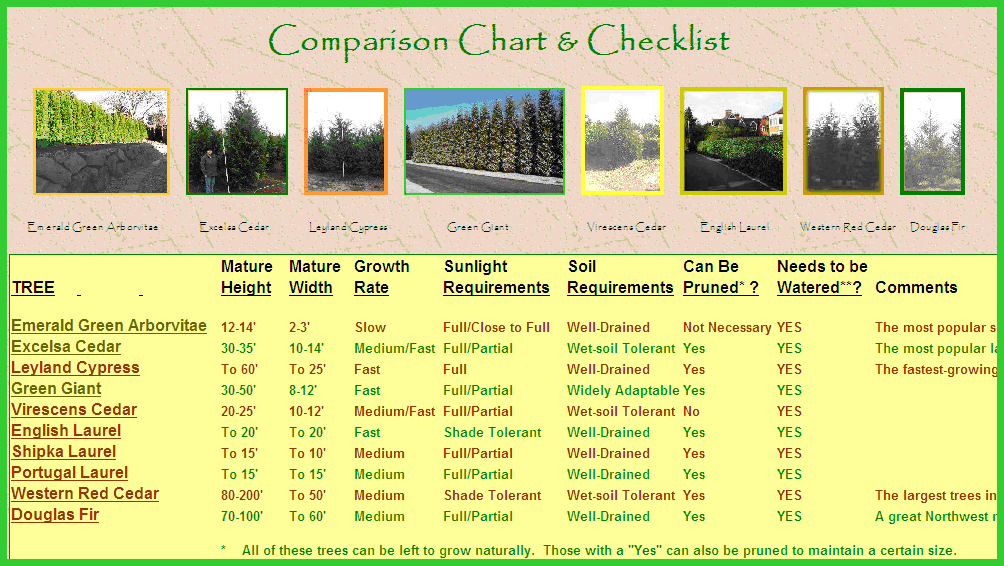
__________________________________

"Top 10 Privacy Trees in Washington State"
This article discusses privacy tree options, pros and cons, growing conditions,
with "Before & After" photos. Click here.
__________________________________
See our Trees Growing in the Fields!

We have a beautiful 8 minute drone video of our Snohomish tree farm
with many of the trees identified. Click here
__________________________________

Privacy Trees: We are a nursery tree farm specializing in Privacy Trees for screening. We have several thousand privacy trees growing at our Snohomish farm. Plus we have many years' experience in "what works where", professional planting services, ongoing support, and thousands of satisfied customers. Buying directly from a grower has great advantages--fresh trees, great selection, and low prices--you maximize your purchasing power. For more information click here.
We also have privacy trees that are not available elsewhere, such as our "Hedged Privacy Trees". For many years we have been pruning some of our privacy trees into tall, narrow hedges so we now have "Instant Privacy" trees in a narrow, hedged form. Sometimes these "hedged" trees are the only trees that will fit into the planting space, and no one else in the Northwest has anything like them. You can see our hedged and natural privacy trees in our beautiful 8 minute YouTube Farm Video.
Ornamental Trees: We also have a nice selection of Ornamental Trees, with many of our trees being on the "Great Plant Picks" list for the Pacific Northwest.
Free Estimates: We will help you determine which trees are right for your project, and provide you with free, no-obligation estimates. This is often accomplished by e-mail and phone, usually first using our online Free Estimate Request Form. Where necessary, we will send one of our experts out to review the project (no cost or obligation). More information
Location: We’re conveniently located just 15 minutes north of Woodinville. We’d be happy to have you out. We are a farm, not a retail nursery so we don't keep regular retail hours; instead we set up appointments so that we can focus on your project--we look at photos and plans with you, and drive you around the farm and look at the tree options. More information
Payment: We don’t require any money “up front”—you only pay when the job is completed (unusual exceptions to this are large/special projects or lengthy “holds” on trees). Be careful of contractors asking for “up front” money; they might not come back!
Warranty & Support: When we plant your trees we include staking (if necessary), transplanting fertilizer, and an easy-to-use watering system that hooks into your garden hose. More information. We also give a one year Warranty on trees we plant, for no additional charge. More information We have a detailed “Care of Your Trees” section of our website, and provide ongoing support--we're available to answer your questions as your new trees grow. More information
Customer Service: We pride ourselves on our Customer Service—real people answering the phone. We have an "A+" rating with the Better Business Bureau (their highest rating), are an Angie's List Super Service Award winner, have excellent reviews on Yelp, Google, etc. and a 100% satisfaction rating with eBay.
Our Business: We’ve been in business since 1995 and have a dedicated, experienced staff, most of whom have been with us for many years. More information We sell retail & wholesale, for residential and commercial projects. We are a registered Washington State contractor (License Number: NURSEL*956J1). More information Be sure to hire a registered contractor -- to go to the Department of Labor & Industries website to check a contractor's registration, click here. As it says there: "Unregistered contractors carry no bond or insurance to protect consumers. Consumers can face serious issues if anything goes wrong on a job." These liability risks are in addition to fraud, poor workmanship, worthless warranties, etc. We are fully bonded and insured, of course.
Customer Satisfaction: Most important of all is what our customers think of us:
"I am really pleased with your work. You saved me several thousand dollars, steered me away from trees that wouldn't work, provided healthy and beautiful trees, did a great job planting them, and did everything on time and on schedule. You can quote me." Jo, Vashon Island
"Our privacy bank of trees has done nothing but grow well into maturity. Our back yard and deck area is totally private and the 10 trees your team planted [in 2005] are rich, leathery and dark green. We remark on them every day it seems. Please include me in any of your "Testimonials" as you would be hard pressed to find a more satisfied customer." Jim, Port Orchard
"For quality vs. value, your trees are the best landscape purchase I’ve ever made." Jeff, Seattle
"Michael, I just wanted to pass along a note to tell you how thrilled I am with the trees. The effect they have brought to our new courtyard in the front of our home here in Seattle has exceeded my expectations!" Chip Hanauer, Hydroplane Driver--Click Here to see his project.
"I work in customer service so I know good service when I experience it and you have my top rating. I would definitely recommend you to anyone who needs new landscaping. Thanks again.” Carol, Camano Island
"The [new] trees were a great privacy feature when we sold the last house! We now have a much larger space we want to talk with you about . . " Katherine, Fall City
“My compliments to your crew. We’ve had a lot of contractors working on our house recently and we’ve seen the entire range; and your guys were excellent. The trees make things look so much better—I started smiling as soon as I saw them going in." Holly, Queen Anne
"You guys are the best nursery I've ever done business with! And I have dealt with a few. You did what you said you would, on time with attention to detail rarely found. From the beginning of the quote process all the way through to the last detail you made it easy. And you work to ensure that the trees will thrive after planting with detailed advice, a complementary irrigation system, and a website filled with useful information. Most nurseries will just dump off the goods and tell you best of luck, put some water on them. You provide a quality product that sets you apart. Your crew was friendly, polite and operated as a well organized team. I would recommend you without hesitation! Thanks for doing a great job!” Ryan, Buckley
"We can not believe how beautiful your trees are. The privacy is unbelievable. If you ever need a testimonial let us know. Our yard is perfect! We sit there and say "my oh my”! Suzanne, Tacoma
"I don't think I've ever been as happy with something I've purchased." Sarah, Sammamish
Many More Testimonials (click here)
Studies: Trees Add Value to Property

Our Convenient Location
15 minutes from I-405/Bothell-Woodinville
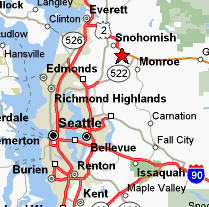
View Directions to our location.
Sales by "Appointment Only", please
Serving Washington State Since 1995
13510 Old Snohomish-Monroe Road
Snohomish, WA 98290
425-343-2650
(425) 953-5780 fax
Sales by "Appointment Only", please
Privacy Trees Ornamental & Landscape Trees Photo Gallery Care of Your Trees
Delivery & Planting Directions & Hours About Us/Contact Us
Privacy Policy, Website User Agreement, and Website Advertiser Agreement Site Map
Copyright 2024, NurseryTrees.com, LLC
